 English
 Español
 Français
 Italiano
 Deutsch
 日本語
 Русский
 العربية
 Português
 Svenska

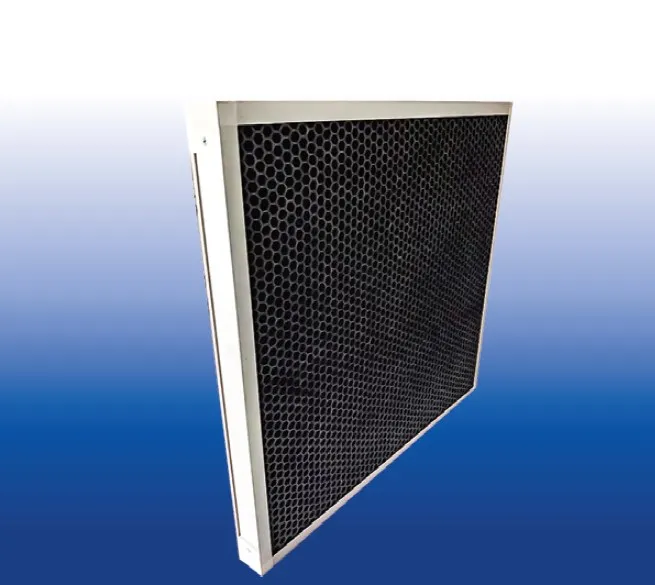
Why Activated Carbon Filters Cannot Replace Particle Filters
Activated carbon filters cannot replace particle filters due to fundamentally different working principles and capture targets. While particle filters physically intercept solids via sieving and inertial impaction, activated carbon relies on molecular adsorption for gases—a mismatch akin to using flypaper to catch fish. This data-driven analysis examines the distinct mechanisms, engineering data, and practical constraints that make these filtration technologies non-interchangeable in industrial applications.
Why Activated Carbon Filters Cannot Replace Particle Filters
Activated carbon filters cannot replace particle filters because their working principles and capture targets are fundamentally different. It’s like using flypaper (activated carbon adsorption) to catch fish instead of a fishing net (particle filtration)—the tools and targets are mismatched. Below is a detailed breakdown based on engineering data and first principles.
1. Different Principles: Physical Interception vs. Molecular Adsorption
| Aspect | Particle Filter | Activated Carbon Filter |
|---|---|---|
| Working Principle | Physical interception of solid/liquid particles via sieving, inertial impaction, interception, and diffusion through tortuous pathways. | Physical and chemical adsorption on enormous internal surface area (van der Waals forces + chemisorption). |
| Key Data Point | HEPA H13: 99.99% efficiency for particles in the 0.001–0.1 μm range. | Specific surface area: 650 – 1,100 m²/g (up to 1,600 m²/g in premium grades). |
| Primary Target | Solid/liquid particulates (dust, pollen, smoke, bacteria, viruses). | Gaseous molecular contaminants (VOCs, chlorine, odors, chemical vapors). |
2. Different Targets: Particles vs. Gaseous Pollutants
| Comparison Dimension | Particle Filter | Activated Carbon Filter |
|---|---|---|
| Primary Target | Solid/liquid particles (dust, pollen, bacteria, viruses, smoke) | Gaseous molecules (odors, VOCs, chlorine, ozone, chemical vapors) |
| Typical Application | Air purifiers, HVAC, cleanrooms, water pre‑filtration | Water dechlorination/odor removal, air purifiers (VOCs), gas masks |
| Performance Example | HEPA H13: ≥99.97% @ 0.3 μm; 99.99% in 0.001–0.1 μm range. | Adsorption rate for chlorine/benzene: typically >95% under optimal conditions. |
| Limitation | Cannot remove gases, odors, or chemical vapors. | Cannot capture solid particles; becomes saturated and needs regular replacement. |
3. Why They Cannot Substitute Each Other
3.1 Functional Incompatibility
- Particle filters cannot remove gases: They have no capacity to adsorb or neutralize gaseous molecules. If your goal is to remove chlorine odor from water, a sediment filter (particle filter) is completely ineffective.
- Activated carbon filters cannot capture particles: Solid particles like dust, pollen, or sand will simply pass through the gaps between activated carbon granules. Even with compressed carbon blocks, the primary function remains adsorption, not mechanical sieving. Moreover, particulate matter quickly clogs the micropores, drastically reducing adsorption efficiency.
3.2 Practical Limitations: Saturation and Lifecycle
- Activated carbon has a finite adsorption capacity. Once its pores are filled, it becomes saturated and must be replaced. For example:
- In typical air purification: activated carbon lasts 3–6 months before saturation.
- In water treatment: capacity depends on contaminant concentration and flow rate.
- Particle filters (especially pre‑filters) can often be vacuumed or washed (if washable) and generally have a longer operational life, though HEPA filters are not washable and need replacement when clogged.
Complementary, not competitive: In real‑world systems, they are used together. A typical filtration train uses:
- Particle pre‑filter – removes large dust/debris to protect the carbon from clogging.
- Activated carbon filter – removes gases, VOCs, and odors.
- Optional HEPA filter – removes fine particles for high‑purity air.
4. Summary: Complementary, Not Replaceable
Quick Answer Matrix
| Question | Answer |
|---|---|
| Can activated carbon replace a particle filter? | No. It cannot physically capture solid particles and will either allow them to pass through or become rapidly clogged. |
| Can a particle filter replace activated carbon? | No. It cannot adsorb gases, odors, or chemical vapors. |
| What is the optimal solution? | Use both in series: Particle pre‑filter → Activated carbon → (Optional) High‑efficiency particle filter. |
Final Takeaway: Activated carbon and particle filters are complementary technologies, not substitutes. Each addresses a different class of contaminants, and their combined use provides comprehensive purification. Choosing one over the other is not a matter of “which is better,” but of matching the filter to the specific contaminant you need to remove.
Please login to write a comment after