 English
 Español
 Français
 Italiano
 Deutsch
 日本語
 Русский
 العربية
 Português
 Svenska

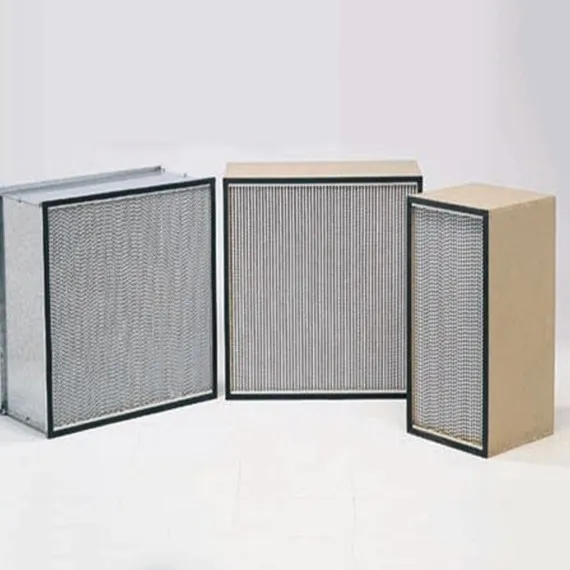
What Is a HEPA Filter and How Does It Work
HEPA filters capture 99.97% of particles at 0.3 microns. Here's how they actually work, where they're used, and what buyers often get wrong about efficiency ratings and filter life.
The 0.3-Micron Number Everyone Quotes
Ask ten suppliers what a HEPA filter is and nine will say “99.97% at 0.3 microns.” That number comes from IEST-RP-CC001 and EN 1822, and it’s the threshold for a true HEPA grade. But here’s what the spec sheet doesn’t tell you: 0.3 microns is not the hardest particle size to catch. Particles around 0.1 to 0.2 microns are actually more difficult because they sit in the gap between diffusion and interception. A filter rated at 99.97% at 0.3 microns will typically perform better at 0.1 microns and better again at 1 micron. The 0.3-micron figure is a testing convention, not a worst-case guarantee.
We’ve had buyers in Germany and the US ask for “99.99% at 0.1 microns” without realizing that’s a ULPA rating, not HEPA. Knowing the difference saves you from overpaying for filtration you don’t need—or undersizing for a cleanroom that actually requires it.
How HEPA Media Actually Traps Particles
HEPA filters are not sieves. The media is a mat of randomly oriented borosilicate microfibers, typically 0.5 to 5 microns in diameter, and the gaps between fibers are much larger than the particles being captured. Four mechanisms do the work:
- Interception: A particle following an airstream gets close enough to a fiber to stick.
- Inertial impaction: Larger particles can’t follow the airstream around a fiber and slam into it.
- Diffusion: Very small particles move erratically (Brownian motion) and collide with fibers.
- Electrostatic attraction: Some media carry a static charge that pulls particles in. This is common in HVAC-grade filters but less so in true HEPA, where the charge can degrade over time.
This is why filter media selection matters more than pleat count. A filter with 50 pleats per foot of high-quality media will outperform one with 80 pleats of cheap, inconsistent fiber. We’ve seen this in side-by-side tests: two filters with identical external dimensions, one at 99.97% and the other at 99.5%, both claiming HEPA. The difference was the media’s fiber diameter distribution.

Where HEPA Filters Fit in Real Systems
HEPA filters rarely work alone. In a pharmaceutical cleanroom, you’ll find a pre-filter (G4 or MERV 8), a medium-efficiency filter (F7-F9 or MERV 13-15), and then the HEPA stage. The pre-filter catches lint and large dust; the medium stage handles finer particles; the HEPA does the final 99.97% capture. Skip the pre-filter and your HEPA loads up in weeks instead of months.
In HVAC systems, the same logic applies. A HEPA filter installed directly in a rooftop unit without upstream filtration will see its pressure drop climb from 250 Pa to 600 Pa in under three months. We’ve tracked this with customers in the Middle East—dust storms cut HEPA filter life by 40-60% compared to temperate climates. That’s not a filter defect; it’s a system design issue.
For industrial processes, HEPA filters sometimes appear in liquid filtration, but that’s a different animal. A HEPA-grade membrane in water filtration is rated by beta ratio, not particle capture efficiency. Don’t confuse the two.
What Buyers Get Wrong About Efficiency Ratings
The most common mistake we see is treating HEPA as a single grade. EN 1822 splits it into H13 (99.95% at MPPS) and H14 (99.995% at MPPS). IEST splits it into Type A, B, C, D based on leakage and testing method. A filter that passes H13 in Europe might not meet IEST Type C in the US because the test aerosols differ—DEHS vs. PAO vs. polystyrene spheres.
Another issue: “99.97%” is a capture efficiency, not an air quality guarantee. If the filter housing leaks, or the gasket fails, you can have a 99.97% filter and still measure 10,000 particles per cubic foot downstream. That’s why technical guides on installation and leak testing matter as much as the filter spec.
We had a customer in Southeast Asia who bought H14 filters for a semiconductor fab. They passed incoming inspection but failed on-site particle counts. Turned out the filter frames were slightly warped—0.5mm out of spec—and the gaskets didn’t seal. The filters were fine; the housing wasn’t.
When to Replace—and When to Clean
HEPA filters are not cleanable. You can vacuum the upstream face to remove loose dust, but the media itself cannot be washed or restored. Once the pressure drop reaches 2x the initial value (typically 500-600 Pa for a clean filter), it’s time to replace. Trying to extend life by cleaning usually damages the media and creates pinhole leaks.
That said, pre-filters are cleanable or replaceable, and that’s where maintenance effort should go. A filter maintenance schedule that changes pre-filters every 3 months and HEPAs every 18-24 months is typical for cleanrooms. In heavy dust environments, cut those intervals by half.
For high-purity applications, we recommend tracking pressure drop weekly and particle counts monthly. If you see a sudden jump in pressure drop, check for upstream filter failure or fan issues before assuming the HEPA is done.
HEPA vs. ULPA vs. EPA: A Quick Reality Check
EPA (E10-E12) captures 85-99.5% at MPPS. HEPA (H13-H14) captures 99.95-99.995%. ULPA (U15-U17) captures 99.9995% and above. The jump from HEPA to ULPA typically doubles or triples filter cost and pressure drop. For most commercial buildings and even many cleanrooms (ISO 7 and 8), HEPA is sufficient. ULPA is for ISO 5 and below—semiconductor lithography, some pharma sterile fill, and certain hospital isolation rooms.
We’ve seen buyers default to ULPA “just to be safe.” That’s an expensive habit. Match the filter to the required ISO class, not to a feeling.
If you’re comparing HEPA against other filtration technologies, our product knowledge section covers the trade-offs in more detail. And for application-specific questions—high humidity, corrosive environments, high-temperature exhaust—the answer usually comes down to media selection and housing design, not the HEPA rating itself.
Please login to write a comment after