 English
 Español
 Français
 Italiano
 Deutsch
 日本語
 Русский
 العربية
 Português
 Svenska

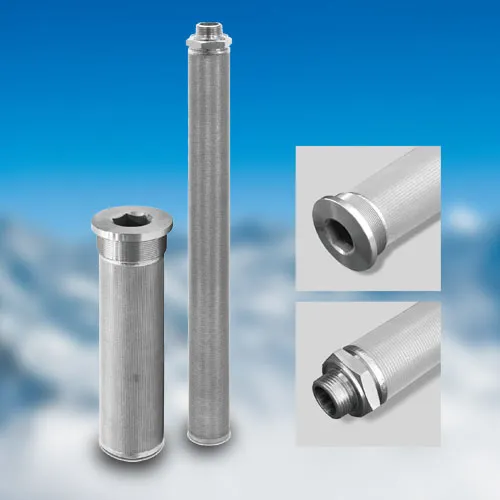
Comparison of Hydrophobic Performance Between Sintered PTFE and Metal Filters
Sintered PTFE offers bulk hydrophobicity with stable water entry pressures of 750–1400 mbar, while metal filters rely on surface modification, trading durability and pore precision.
- 1. Physical Basis of Hydrophobicity: Surface Energy Sets the “Ceiling”
- 2. Contact Angle and Water Entry Pressure: Data Comparison
- 3. Coupling Between Mechanical Integrity and Hydrophobicity: Data Reveal Structural Trade-offs
- 4. Engineering Criteria for Selection: Not “Substitution,” but “Division of Roles”
Comparison of Hydrophobic Performance Between Sintered PTFE and Metal Filters: Intrinsic Material Properties and Engineering Boundaries Supported by Data
1. Physical Basis of Hydrophobicity: Surface Energy Sets the “Ceiling”
The surface tension of water is 72.8 mN/m. The lower the solid surface energy, the larger the water contact angle on that solid. The repeating unit of PTFE—CF₂—gives it one of the lowest surface energies among known polymers: literature values are concentrated in the range of 18–20 mN/m, corresponding to a flat-surface water contact angle baseline of approximately 110°–120°. This value is a “material constant” of PTFE hydrophobicity and does not depend on any coating or post-treatment.
The situation for metal filters is fundamentally different. The intrinsic surface energies of commonly used sintered metals such as stainless steel and nickel-based alloys are much higher than that of PTFE, and without modification they do not possess stable hydrophobic capability. To achieve hydrophobicity, metal filters must introduce foreign low-surface-energy substances or micro/nanoscale rough structures. This means that the performance ceiling of hydrophobic metal filters is not determined by the substrate, but by the chemical composition, coverage integrity, and structural stability of the modification layer.
2. Contact Angle and Water Entry Pressure: Data Comparison
Table 1: Key Hydrophobicity Data for PTFE and Metal Filters
| Material/System | Surface Energy (mN/m) | Water Contact Angle | Water Entry Pressure / Water Resistance | Pore Size / Structural Condition | Source of Hydrophobicity |
|---|---|---|---|---|---|
| Sintered PTFE (conventional engineering form) | 18–20 | 110°–120° | PMV27: 750–1050 mbar; BM120: 840–1400 mbar | Thickness 0.19–3.0 mm; Porex PM-0130: 1–2 μm, 103–207 kPa | Bulk C—F bonds, intrinsic to material |
| Superhydrophobic PTFE (roughened) | 18–20 | 162±2°, sliding angle 7° | — | Micro/nanoscale roughness constructed by cold pressing and sintering | Intrinsic low surface energy + rough structure |
| Superhydrophobic copper mesh/stainless steel mesh | High surface energy of metal substrate | >150° (stainless steel mesh 163.8±1.8°) | 122 μm pore size: 4900 Pa (49 mbar) | Mesh opening 122 μm; stainless steel mesh 75 μm | Modification coating + rough structure |
| Boron nitride nanotube stainless steel filter mesh | — | Approximately 150°, sliding angle 3° | — | Stainless steel filter mesh substrate | Nanotube coating |
| Modified metal filter mesh (HDTMS/SiO₂, etc.) | — | 120° after hydrophobic modification (stable after external force) | — | Metal filter mesh | Surface chemical modification |
Data sources and interpretation: The PTFE water entry pressure data come from Porex Virtek series engineering specifications; the Porex PM-0130 sintered PTFE granular filter material, with a pore size of 1–2 μm and a water intrusion pressure of 103–207 kPa, further confirms the engineering achievability of PTFE hydrophobicity at submicron-to-micron pore sizes. The water pressure resistance data for metal meshes are represented by the 4900 Pa value for a copper mesh with 122 μm pore size; stainless steel meshes with the same pore size show similar hydrophobicity. The boron nitride nanotube stainless steel filter mesh, with a contact angle of approximately 150° and a sliding angle of 3°, is a typical example of modified metal filters “catching up to or even exceeding” conventional PTFE in contact-angle values.
Key observation: In terms of contact angle, modified metal filters can reach above 150°, numerically exceeding the 110°–120° of conventional sintered PTFE. However, in terms of water entry pressure, metal mesh data are concentrated at the tens-of-millibar level (49 mbar at 122 μm pore size), whereas sintered PTFE membranes reach 750–1400 mbar at similar or smaller pore sizes. This gap cannot be attributed entirely to pore-size differences—PTFE membranes still have water intrusion pressures on the order of approximately 1030–2070 mbar at 1–2 μm pore sizes—it reflects a difference in continuity of pore-wall surface chemistry and structural integrity of capillary resistance. The modification layer on metal meshes generally cannot form a continuous, low-defect perfluorinated coating on the inner walls of the pores in the same way that sintered PTFE can.
3. Coupling Between Mechanical Integrity and Hydrophobicity: Data Reveal Structural Trade-offs
Table 2: Comparison of Mechanical and Chemical Resistance
| Dimension | Sintered PTFE | Metal Filters (after modification) |
|---|---|---|
| Compressive strength/structural load-bearing | Compressive strength 0.8 MPa; working pressure differential 0.42 MPa; average tensile strength of pure PTFE approximately 28 MPa | Stainless steel sintered bodies can operate up to 600–900°C, with high compressive strength and impact resistance |
| Porosity | 30–55% (some products above 50%) | Generally below 30% for metal sintered filter elements |
| Failure mode of hydrophobicity | Bulk hydrophobicity; after scratching, the newly exposed surface is still low-surface-energy PTFE | Local damage to the modification layer → exposed metal substrate → spatially non-uniform decay of hydrophobicity |
| Public durability data | — | HDTMS/SiO₂-modified stainless steel filter mesh maintains a contact angle of 120° under external force; PDMS-SiO₂ coating on stainless steel mesh shows better mechanical toughness than other mesh types |
Data sources: The compressive strength of 0.8 MPa and working pressure differential of 0.42 MPa for sintered PTFE filter elements come from product specifications; the average tensile strength of pure PTFE of approximately 28 MPa is a literature summary value. The temperature resistance of 600–900°C for metal sintered filters is an established industry performance. The porosity comparison comes from PTFE sintered filter element product data. The data showing that modified metal filter meshes maintain a contact angle of 120° under external force come from durability tests of hydrophobic/hydrophilic modified metal filter meshes.
The core issue revealed by this comparison is not that “metal filters are not strong,” but that the structural advantages of metal filters do not automatically translate into durable advantages in hydrophobic performance. Precisely in high mechanical load, backwashing, or particle erosion scenarios, the modified hydrophobic layer—the sole source of hydrophobicity for metal filters—faces the greatest test of integrity. PTFE hydrophobicity does not have this failure mode: even if the surface is slightly scratched, the newly exposed surface is still low-surface-energy PTFE bulk material.
4. Engineering Criteria for Selection: Not “Substitution,” but “Division of Roles”
Placing the above data within the same decision framework makes the applicable boundaries of the two paths clear.
If the core challenge is stable gas–liquid separation in corrosive, high-temperature, or high-pressure environments, sintered PTFE is a more reliable baseline choice. Its hydrophobicity comes from the material itself, and engineering data on water entry pressure (on the order of 750–1400 mbar; Porex PM-0130 at 103–207 kPa for 1–2 μm pore size) provide a predictable lower bound for design. The cost is that structural compensation is needed under extreme mechanical loads or pulsed pressure: the compressive strength of 0.8 MPa and working pressure differential of 0.42 MPa for sintered PTFE bodies are lower than those of metal sintered bodies, so the pressure-differential limit must be incorporated as a design constraint.
If the application requires the load-bearing capacity, electrical/thermal conductivity, or higher pore-size precision of a metal framework, surface-modified metal filters are a necessary path. However, the core of selection verification should not stop at the static indicator of “whether the contact angle after modification is greater than 150°.” Instead, it should focus on measured water entry pressure at the target pore size, the retention rate of modification-layer integrity under expected mechanical/chemical stress, and the decay mode of hydrophobicity after local damage. The “lead” of metal filters in contact-angle values is conferred by the modification process, and its engineering credibility depends on whether the modification layer can maintain its chemical and structural integrity throughout the full life cycle of the filter.
Please login to write a comment after