 English
 Español
 Français
 Italiano
 Deutsch
 日本語
 Русский
 العربية
 Português
 Svenska

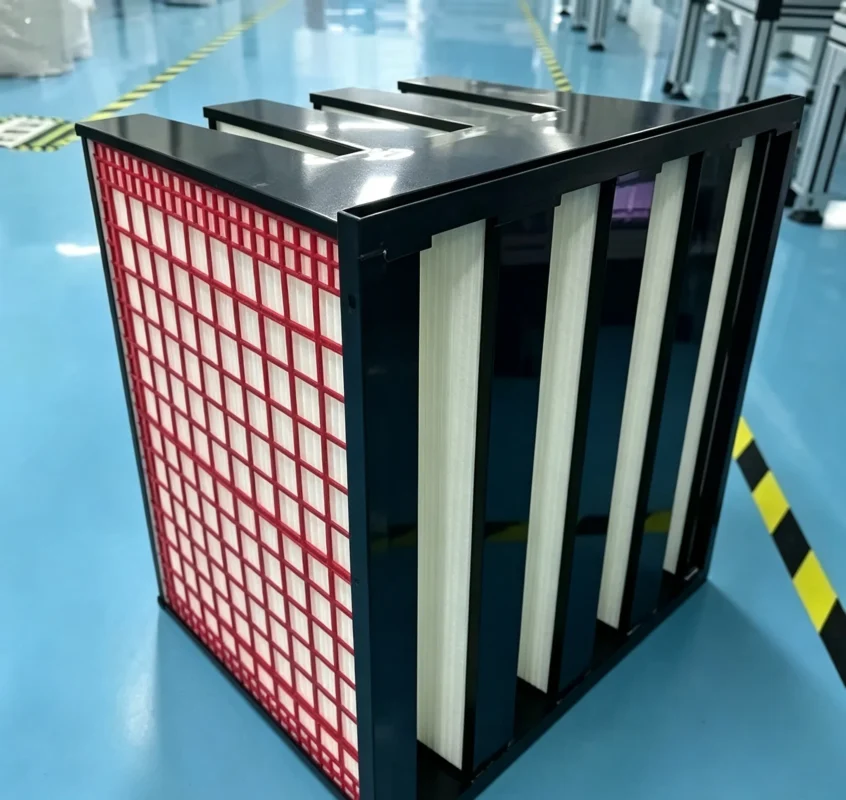
V-Bank Panel Filters: A Technical Deep Dive into Product Features
From structural strength to filtration efficiency, V-bank panel filters fold media into continuous V-channels to maximize area, maintain form under 62.5 kPa, and keep deflection within 25 mm.
- Core Conclusion
- I. Structural Design Features: How V-Shaped Channels Change the Filtration Logic
- 1.1 Space Efficiency of the Separatorless V-Bank Structure
- 1.2 Quantified Indicators of Structural Strength
- 1.3 Engineering Details of Support Members
- II. Filtration Performance Data: Efficiency Span from F5 to H10
- 2.1 Correspondence Between Filtration Grades and Efficiency
- 2.2 Balancing Airflow and Resistance
- 2.3 Dust-Holding Capacity and Service Life
- III. Material and Frame Features: The Logic of Choosing from Fiberglass to Non-Woven Fabric
- 3.1 Performance Comparison of Filter Media Types
- 3.2 Frame Material Adaptation to Application Scenarios
- 3.3 Environmental Tolerance Parameters
- IV. Application Scenarios and Selection Logic
- V. Technology Development Trends
- Conclusion
V-Bank Panel Filters: A Technical Deep Dive into Product Features — From Structural Strength to Filtration Efficiency
Core Conclusion
The core value of V-bank panel filters (also known as V-bank filters or W-type filters) lies in maximizing effective filtration area within a limited installation space. By folding filter media into continuous V-shaped channels, a single standard 592×592×292 mm V-bank filter can deliver a rated airflow of up to 3,400 m³/h, while achieving filtration efficiency of over 99.99% for 0.3 μm particles. Its structural design can withstand pressure differentials of 62.5 kPa or more while essentially maintaining its form, with deflection controlled within 25 mm. This means a V-bank panel filter is not simply “filter media plus a frame”—it is a precision-engineered filtration system designed for high airflow, high dust-holding capacity, and high structural strength.
I. Structural Design Features: How V-Shaped Channels Change the Filtration Logic
1.1 Space Efficiency of the Separatorless V-Bank Structure
Traditional high-efficiency filters with separators use corrugated separators to maintain pleat spacing, whereas V-bank panel filters adopt a separatorless design—there are no common grid separators inside, so airflow is not reduced by wall resistance. The direct result of this design is that at the same airflow, V-bank filters can use fewer filter units, reducing costs, saving installation space, and cutting installation time.
At the numerical level, a standard V-bank filter (592×592×292 mm) can achieve a rated airflow of 3,400 m³/h, while a traditional separator-type filter of the same face dimensions typically handles only about half that airflow. This efficiency difference stems from the V-bank structure arranging filter media in a “V” or “W” configuration, multiplying the effective filtration area.
1.2 Quantified Indicators of Structural Strength
V-bank panel filters are not simply “filter media plus a frame.” According to technical data disclosed in patent literature, their structural design has clear mechanical quantitative standards:
- Under a fluid pressure of at least 1 kPa on the upstream surface of the filter media, the filter media deflects outward from the vertical axis by no more than 20 mm
- The V-bank filter assembly can be constructed to withstand pressure differentials of approximately 62.5 kPa or greater while essentially maintaining its structure
- During fluid filtration, deflection at any location along the filter media is controlled to less than approximately 25 mm
These data demonstrate that V-bank panel filters have clearly defined structural reliability guarantees under high-pressure-differential conditions (such as gas turbine intake filtration and high-velocity ventilation systems). The support member design ensures that the pressure differential increase caused by the support members does not exceed 10%, enhancing structural integrity while barely sacrificing airflow performance.
1.3 Engineering Details of Support Members
The support members of V-bank filters involve refined engineering considerations. Patent literature describes support members with a T-shaped cross-section: a first portion extending along the downstream surface of the filter pleat pack, and a second portion extending into the pleated configuration within the pleats. The support members may include multiple holes to avoid impeding airflow, and multiple support members are interconnected by bridging members, which are provided with multiple tabs and gaps between the tabs.
Regarding filter bag strength, each group of filter bags is secured with metal strips to increase filter screen strength and prevent the bags from rupturing due to wind friction at high velocities. This design detail addresses the practical challenges V-bank filters face in high-velocity systems.
II. Filtration Performance Data: Efficiency Span from F5 to H10
2.1 Correspondence Between Filtration Grades and Efficiency
V-bank panel filters cover a broad efficiency range from medium efficiency (F5) to sub-high efficiency (H10), with different grades corresponding to different filter materials and efficiency indicators:
| Filtration Grade | Filtration Efficiency | Color Identification | Corresponding European Standard |
|---|---|---|---|
| F5 | 40–45% | Earth yellow | EN779 F5 |
| F6 | 60–65% | Green | EN779 F6 |
| F7 | 80–85% | Pink / light pink | EN779 F7 |
| F8 | 90–95% | Light yellow | EN779 F8 |
| F9 | 95% | White | EN779 F9 |
| H10 | ≥99.99% (0.3 μm) | — | EN1822 H10 |
It should be noted that F5–F9 grades are typically tested using the colorimetric method, while H10 and above use the particle counting method (for 0.3 μm particles). Filtration precision can reach 0.5 μm (for F grades) to 0.3 μm (for H grades).
2.2 Balancing Airflow and Resistance
An important product advantage of V-bank panel filters is low initial resistance. Initial resistance data for standard specifications are as follows:
| Specification (mm) | Rated Airflow (m³/h) | Initial Resistance (Pa) |
|---|---|---|
| 592×287×292 | 1,500 | ≤200 |
| 592×490×292 | 2,400 | ≤200 |
| 592×592×292 | 3,000–3,400 | ≤200–250 |
When filter resistance reaches 400 Pa or above, the filter must be replaced. The difference between this “final resistance” and the initial resistance (approximately 200 Pa) constitutes the resistance window for the filter’s entire service life.
2.3 Dust-Holding Capacity and Service Life
The dust-holding capacity data of V-bank panel filters directly determines the replacement cycle:
- For the 592×592×292 specification, dust-holding capacity can reach 800–900 g (fiberglass media)
- Under rated airflow conditions, the filter requires replacement in 3–4 months
- If the ambient dust concentration is high, the service life will be further reduced
“Washable filter media” allows a maximum of two washings, after which a new filter must be installed. This limitation relates to the microscopic structural characteristics of the media—repeated washing causes fiber structure loosening and electrostatic layer failure.
III. Material and Frame Features: The Logic of Choosing from Fiberglass to Non-Woven Fabric
3.1 Performance Comparison of Filter Media Types
The choice of filter media directly affects the efficiency grade and service life of V-bank panel filters:
Fiberglass filter paper: Offers higher dust-holding capacity per unit area and is unaffected by electrostatic effects, but has higher raw material costs and lower strength than synthetic fibers. Fiberglass media is suitable for scenarios requiring high efficiency stability, such as cleanroom terminal filtration and high-temperature environments.
Polyester fiber / synthetic fiber filter paper: Lower cost, suitable for medium-efficiency pre-filtration scenarios. When using polyester fiber (PP) in the standard 592×592×292 specification, dust-holding capacity is approximately 800 g; with fiberglass, it can reach 900 g.
Ultra-fine synthetic fiber filter paper: Described as having “large effective filtration area, low resistance, small space occupation, sturdy and durable, non-toxic and odorless.”
3.2 Frame Material Adaptation to Application Scenarios
V-bank panel filter frame materials are selected according to the application environment:
- ABS engineering plastic frame: Lightweight, low initial resistance, suitable for high-velocity systems, variable air volume systems, high-humidity, or corrosive environments
- Galvanized steel / aluminum frame: Higher strength, suitable for general industrial ventilation systems
- Aluminum alloy frame: Balances lightweight and strength, a relatively common choice
- Stainless steel frame: Suitable for extremely corrosive environments or high-temperature scenarios
3.3 Environmental Tolerance Parameters
V-bank panel filters have clearly defined boundaries for environmental tolerance:
- Temperature resistance: Typically 80°C; some high-temperature separator-type models can reach 150°C or even 350°C (using high-temperature silicone sealing)
- Humidity: Can withstand 100% relative humidity
- Sealant: Thermoplastic pleat separators ensure consistent pleat spacing, guaranteeing airflow passes through with minimal resistance
Another key function of thermoplastic pleat separators is ensuring consistency of pleat spacing, thereby fully utilizing the filter media throughout its entire depth to achieve greater dust-holding capacity.
IV. Application Scenarios and Selection Logic
4.1 Main Application Areas
The application scenarios of V-bank panel filters closely match their characteristics of “high airflow, low resistance, large dust-holding capacity”:
Cleanrooms and pharmaceutical industry: Serving as front-end pre-filtration for high-efficiency filtration systems, extending the service life of high-efficiency filters. In scenarios such as pharmaceuticals, biological laboratories, and hospital operating rooms, V-bank filters play the role of “protecting terminal high-efficiency filters.”
Gas turbine intake filtration: V-bank panel filters are “typically used in applications for removing airborne particulates to protect gas turbines from corrosion, fouling, and performance loss.” This application places extremely high demands on structural strength—gas turbine intake velocities are high and pressure differentials fluctuate greatly, and the 62.5 kPa pressure differential resistance of V-bank filters is designed precisely for this.
Large civil building ventilation: Pre-filtration for centralized ventilation and air conditioning systems in office buildings, hospitals, shopping malls, stadiums, airports, and other large civil buildings, as well as general industrial plants or cleanroom centralized ventilation and air conditioning systems.
Livestock farming: Environments such as pig farms have special air filtration needs, and V-bank saddle panel filters are used in such scenarios.
4.2 Core Selection Parameters
When selecting V-bank panel filters, the core parameters to focus on include: filtration efficiency grade (F5–H10), rated airflow (typically 1,500–3,400 m³/h), initial resistance (typically ≤200 Pa), dust-holding capacity (400–900 g), frame material (plastic/galvanized/aluminum/stainless steel), temperature limit (80°C standard), and dimensions (standard 592×592×292 mm, other sizes customizable).
The selection logic can be summarized as: airflow determines specification size, efficiency determines media type, environment determines frame material, and dust concentration determines replacement frequency. For high-humidity or corrosive environments, ABS plastic frames should be prioritized; for high-temperature environments, high-temperature models should be selected with confirmation of the sealant’s temperature rating; for scenarios with high dust concentrations, the replacement cycle should be shortened or fiberglass media with higher dust-holding capacity should be chosen.
V. Technology Development Trends
The technological evolution of V-bank panel filters is concentrated in three dimensions:
Structural optimization: Patent technology is exploring more efficient support member designs that minimize pressure differential increase while enhancing structural strength. The pressure differential increase caused by support members is controlled within 10%, and this indicator still has room for further optimization.
Material compositing: Multi-functional composite membrane panel filters combine activated carbon fiber with general filtration materials to achieve dual functions of adsorption and interception—not only achieving good filtration of airborne dust but also excellent filtration of certain inorganic gases, organic vapors, and more. This compositing trend is driving V-bank filters from single-function dust removal equipment toward multi-functional air purification units.
Efficiency boundary expansion: From the current mainstream F5–H10 grades, V-bank panel filters are extending toward higher efficiency grades. Multi-layer high-efficiency panel filters use separator-type designs, where corrugated separators can precisely maintain pleat spacing; in corrosive environments, vinyl-coated separators can be used, capturing 0.12 μm particles with 99.9999% efficiency. This indicates that the technical potential of the V-bank structure has not yet been fully realized.
Conclusion
The product features of V-bank panel filters can be summarized in one sentence: trading structural design for space efficiency, and material selection for performance boundaries. Separatorless V-shaped channels maximize the effective filtration area on a limited face area; T-shaped support members impart structural rigidity capable of withstanding 62.5 kPa pressure differentials with virtually no added resistance; and the flexible choice of filter media from synthetic fiber to fiberglass allows the same structure to cover the complete efficiency spectrum from F5 to H10. For scenarios requiring reliable filtration under high airflow, limited space, and harsh environments, V-bank panel filters provide a data-validated technical solution.
Please login to write a comment after