 English
 Español
 Français
 Italiano
 Deutsch
 日本語
 Русский
 العربية
 Português
 Svenska

Common Filter Media Materials and Applications: A Comprehensive Guide from PP Cotton to PTFE
Choosing the right filter media matters. This guide covers key materials, their performance traits, and where each fits in real-world filtration systems.
- Core Conclusion
- I. Coarse Filtration and Pre-Treatment Materials: PP Cotton and Non-Woven Fabric
- II. Adsorption and Chemical Removal Materials: Activated Carbon
- 2.1 Adsorption Capacity of Activated Carbon
- 2.2 Differences Between Carbon Block and Granular Carbon
- 2.3 The Boundaries of Activated Carbon
- III. Membrane Filtration Materials: From Microfiltration to Reverse Osmosis
- 3.1 Hollow Fiber Membrane (Ultrafiltration/Microfiltration)
- 3.2 PES (Polyethersulfone)
- 3.3 PVDF (Polyvinylidene Fluoride)
- 3.4 PTFE (Polytetrafluoroethylene)
- IV. Material Selection Logic in Industry Applications
- 4.1 Food and Beverage
- 4.2 Pharmaceutical and Biological
- 4.3 Semiconductor and Electronics
- 4.4 Chemical Industry
- V. Special Material Considerations in Gas Filtration
- VI. The Core Logic of Selection Decisions
- Conclusion
Common Filter Media Materials and Applications: A Comprehensive Guide from PP Cotton to PTFE
Core Conclusion
The “performance boundary” of a filter element is almost entirely determined by its material. With the same housing structure, changing the filter media can alter filtration precision, temperature tolerance, and chemical compatibility by dozens or even hundreds of times. Polypropylene (PP) filter elements have a maximum temperature tolerance of 80°C, while polytetrafluoroethylene (PTFE) can withstand over 200°C for extended periods. Activated carbon can have a specific surface area of hundreds of square meters per gram, capable of adsorbing residual chlorine, organic compounds, and some heavy metals—yet it barely intercepts particulate matter at all. Understanding filter media materials means understanding a simple engineering trade-off: what you need to intercept, under what conditions, and at what cost.
I. Coarse Filtration and Pre-Treatment Materials: PP Cotton and Non-Woven Fabric
1.1 PP Cotton (Polypropylene Melt-Blown Filter Element)
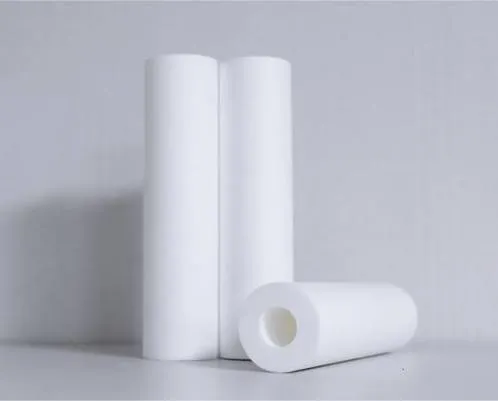
PP cotton is the most widely used material in water treatment and air coarse filtration. According to the Chinese national standard “Water Treatment Cores for Household and Similar Purposes” (GB/T 30306-2013), PP cotton is a core filter material for “coarse filtration cores.” Its manufacturing process is primarily melt-blowing: fibers are extruded at high temperature and entangle with each other to form a three-dimensional mesh structure.
The core advantages of PP cotton are low cost, good chemical stability, and no introduction of pollutants. In liquid filtration, PP filter elements have nominal precision ranging from 0.1 microns to 30 microns, and a 10-inch filter element has an effective filtration area of approximately 0.23 m². In air filtration, PP melt-blown non-woven layers are typical media for coarse and medium-efficiency filters, featuring “stable quality, large dust-holding capacity, strong moisture resistance, long service life, and economic durability.”
The limitations of PP cotton are equally clear: maximum temperature tolerance of approximately 80°C, above which the fiber structure softens and deforms; as a depth filtration medium, its interception of fine particles relies on physical entanglement of fibers rather than precise pore size, so efficiency declines relatively quickly with use time.
1.2 Non-Woven Fabric and Synthetic Fibers
Non-woven fabric (polyester fiber) is similar to PP cotton, serving as the “basic model” for coarse and medium-efficiency filtration. Synthetic fiber media (such as polyester and polyacrylonitrile) go a step further: under general filtration conditions, synthetic fiber media “can comprehensively replace non-woven fabric and fiberglass to cover the full range of coarse, medium, and high-efficiency (G3-H13) filtration products,” with advantages including low resistance, light weight, large dust-holding capacity, and incinerability.
In air filtration, composite structures of PP melt-blown layers and non-woven layers can significantly improve efficiency. Patent data show that an ABPET non-woven layer (average fiber diameter 2.6 microns) composited with melt-blown polyamide achieves 99.96% efficiency in TSI8130 testing, while either the non-woven layer alone or the melt-blown layer alone achieves lower efficiency.
II. Adsorption and Chemical Removal Materials: Activated Carbon
2.1 Adsorption Capacity of Activated Carbon
Activated carbon is “one of the filter materials with the longest history of use and is indispensable” in the water purification industry. Its core characteristic is enormous specific surface area—its surface and interior are filled with nanoscale micropores, “the smallest being only about 0.05 nanometers.” When water or airflow passes through, residual chlorine, organic compounds (such as trihalomethanes, pesticides, and endocrine disruptors), and some heavy metal ions are adsorbed and intercepted by the micropore surfaces.
The adsorption capacity of activated carbon depends on the distribution of mesopores and micropores: “the more numerous and uniformly distributed the mesopores and micropores in activated carbon, the better the chemical removal rate.” In water purifiers, activated carbon plays two roles: “pre-carbon” protects the reverse osmosis membrane, while “post-carbon” improves taste.
2.2 Differences Between Carbon Block and Granular Carbon
Granular activated carbon (GAC) and carbon block differ significantly in performance. Carbon block is pressed from fine activated carbon powder and polymer binders, and “compared to granular activated carbon, it has a huge surface area, capable of removing volatile organic chemicals as well as bad taste and odor.”
In gravity filtration systems, the porosity of carbon block is a key parameter. When carbon block porosity is less than 2 microns, it can simultaneously remove cysts (such as Cryptosporidium and Giardia). However, traditional tubular carbon block has insufficient flow rate under gravity drive, which led to the development of dome-shaped carbon block designs: water enters from the top and sides, increasing the effective surface area. With hydrophilic modified binders (such as surface-modified UHMWPE), carbon block with porosity less than 2 microns can also achieve acceptable flow rates in gravity systems.
2.3 The Boundaries of Activated Carbon
Activated carbon does not intercept particulate matter; its function is to adsorb dissolved pollutants. In air filtration, activated carbon media “do not emphasize filtration efficiency” and “generally must be used in conjunction with independent coarse and medium-efficiency filters.” This means activated carbon typically exists as a functional layer within composite filter elements, rather than independently handling all filtration tasks.
III. Membrane Filtration Materials: From Microfiltration to Reverse Osmosis
3.1 Hollow Fiber Membrane (Ultrafiltration/Microfiltration)
The filtration principle of hollow fiber membranes is that “small-sized substances such as water molecules in solution can pass through micropores on the membrane wall to the other side, while large-sized substances such as bacteria, colloidal suspensions, and particles cannot penetrate.” Based on pore size, membrane filter elements are classified as microfiltration, ultrafiltration, nanofiltration, and reverse osmosis, with smaller pore size meaning more thorough filtration.
In water purifiers, the typical configuration for ultrafiltration membrane filter elements is “ultrafiltration membrane elements for water purifiers, and reverse osmosis membrane elements for pure water machines.” The advantages of hollow fiber membranes are “small pore size, physical filtration without adverse effects on water quality, and easy regeneration for reuse.” In composite filter elements for gravity-driven water purifiers, hollow fiber membrane modules are used to “filter and remove particulate matter with diameters above 0.1 microns, including microorganisms and bacteria.”
3.2 PES (Polyethersulfone)
PES is one of the most commonly used membrane materials in pleated filter elements, with core characteristics of low protein adsorption and high flux. In the food and beverage industry, PES is used for “beverage sterilization filtration (such as beer, wine, and dairy products)”; in the pharmaceutical industry, PES is used for “terminal sterilization filtration of pharmaceutical liquids.”
PES has moderate chemical compatibility: resistant to acids and bases, but not to strong solvents. In terms of operating temperature, the maximum continuous operating temperature of PES membrane filter elements is approximately 93.3°C (200°F).
3.3 PVDF (Polyvinylidene Fluoride)
PVDF’s positioning lies between PES and PTFE. Hydrophilic PVDF is suitable for biological products and vaccine filtration; in the semiconductor and electronics industries, PVDF is used for “high-purity, chemical filtration.” PVDF has “very good chemical stability and heat resistance, low protein binding,” but is not suitable for strongly corrosive liquids—it cannot withstand acetone, DMSO, THF, DMF, dichloromethane, chloroform, and other solvents.
3.4 PTFE (Polytetrafluoroethylene)
PTFE is the “universal player” among filter materials. Its solvent compatibility is “extensive,” with characteristics of “high flux, high particle retention rate, good temperature resistance, and resistance to strong acids, bases, organic solvents, and oxidants.” In scenarios such as corrosive chemical media filtration, high-purity chemical filtration, and fermenter aeration, PTFE is almost the only choice.
Temperature data for PTFE filter elements: maximum temperature up to 200°C, and “better chemical resistance to certain substances.” In the pharmaceutical and semiconductor industries, PTFE membrane filter elements can operate at temperatures up to 203°F (95°C) with a maximum operating pressure differential of 75 psid (at 70°F).
PTFE is also finely graded: hydrophobic PTFE is used for gas and air filtration, hydrophilic PTFE can be used for aqueous solution filtration, and therefore hydrophilic PTFE is described as a “universal filtration material.”
IV. Material Selection Logic in Industry Applications
4.1 Food and Beverage
Core requirements: compliance with FDA/EU food contact regulations, capable of high-temperature steam sterilization. PES is the first choice for beverage sterilization due to low protein adsorption; Nylon has high mechanical strength for drinking water and juice clarification; PP is acid-base resistant for pre-filtration.
4.2 Pharmaceutical and Biological
Core requirements: compliance with GMP/USP Class VI standards, sterilizable, low protein adsorption. PES is used for terminal sterilization of pharmaceutical liquids, PVDF for vaccines and biological products, PTFE for sterile gas filtration (such as fermenter aeration), and Nylon for buffer solutions and pharmaceutical water sterilization.
4.3 Semiconductor and Electronics
Core requirements: extremely low metal leaching, resistance to high-purity chemicals. PTFE and PFA are the preferred materials. PFA “is suitable for filtration of all liquids and has very good temperature resistance and extremely low ion leaching, particularly suitable for various chemical filtration in the FPD industry and semiconductor industry.” HCP series filters offer pure PP, PVDF, and PFA materials, with PFA withstanding 100°C, and PP and PVDF withstanding 80°C and 100°C respectively.
4.4 Chemical Industry
Core requirements: chemical resistance, temperature resistance, mechanical strength. PTFE resists strong acids, bases, and organic solvents; PVDF has good chemical compatibility for coatings, inks, and fine chemicals; PP is economical and durable for daily chemicals and lubricating oil filtration.
V. Special Material Considerations in Gas Filtration
In air and gas filtration, the temperature resistance and flame retardancy of materials are key selection variables. The choice of filter bag material in baghouse dust collectors directly determines the upper limit of flue gas temperature that can be handled.
According to temperature data for industrial bag filtration media, the continuous operating temperature limits of different materials vary greatly:
| Material | Continuous Operating Temperature Limit | Acid/Base Resistance | Flame Retardancy |
|---|---|---|---|
| Polypropylene (PP) | 200°F (93°C) | Excellent/Excellent | Combustible |
| Polyester | 275°F (135°C) | Moderate/Moderate | Combustible |
| Nomex (Aramid) | 375°F (190°C) | Good/Good | Flame Retardant |
| PPS | 375°F (190°C) | Excellent/Excellent | Flame Retardant |
| P84 | 420°F (215°C) | Excellent/Moderate | Flame Retardant |
| PTFE | 450°F (232°C) | Excellent/Excellent | Flame Retardant |
| Fiberglass | 500°F (260°C) | Good/Moderate | Flame Retardant |
The engineering significance of this table is: with each step up in temperature, the range of available materials narrows sharply. Below 135°C, polyester and PP can handle the job; above 190°C, only PPS, P84, PTFE, and fiberglass are available; and above 232°C, PTFE and fiberglass are almost the only options.
VI. The Core Logic of Selection Decisions
Synthesizing the above material data, the decision chain for filter element selection can be simplified into three questions:
First, what is the filtration target? Particulate interception, dissolved pollutant adsorption, or microbial removal? Particle interception depends on the pore size precision of membrane materials (PP→PES→PTFE with increasing efficiency), adsorption depends on the pore structure and amount of activated carbon, and microbial removal depends on membrane pore size (<0.2 microns) or adsorption media (such as silver-loaded activated carbon).
Second, what are the operating conditions? Temperature determines the material pool (PP can be used below 80°C, only PTFE or fiberglass above 200°C); chemical environment determines compatibility (PTFE for strong acids and bases, PVDF cautiously for organic solvents, free choice for aqueous solutions); pressure determines structural strength.
Third, what is the cost constraint? PP is the most economical, PES is mid-range, PTFE and PFA are the most expensive. On the premise of meeting performance requirements, prioritizing lower-cost materials is a basic principle of engineering selection. The “pre” and “post” design of activated carbon and the layered structure of composite filter elements are essentially about finding a balance between performance and cost.
Conclusion
The selection of filter media materials is essentially a set of engineering boundary matching problems: the 80°C limit of PP cotton, the 93°C limit of PES, and the 200°C+ tolerance of PTFE form the selection ladder in the temperature dimension; the adsorption function of activated carbon and the interception function of membrane materials form the division of labor in the functional dimension; and the progression from FDA food-grade to USP Class VI pharmaceutical-grade to semiconductor-grade ultra-low leaching forms the upgrade path in the compliance dimension. Understanding these material data boundaries is more practically meaningful than remembering “which filter element is best”—there is no best material, only the most suitable material under given conditions.
Please login to write a comment after