 English
 Español
 Français
 Italiano
 Deutsch
 日本語
 Русский
 العربية
 Português
 Svenska

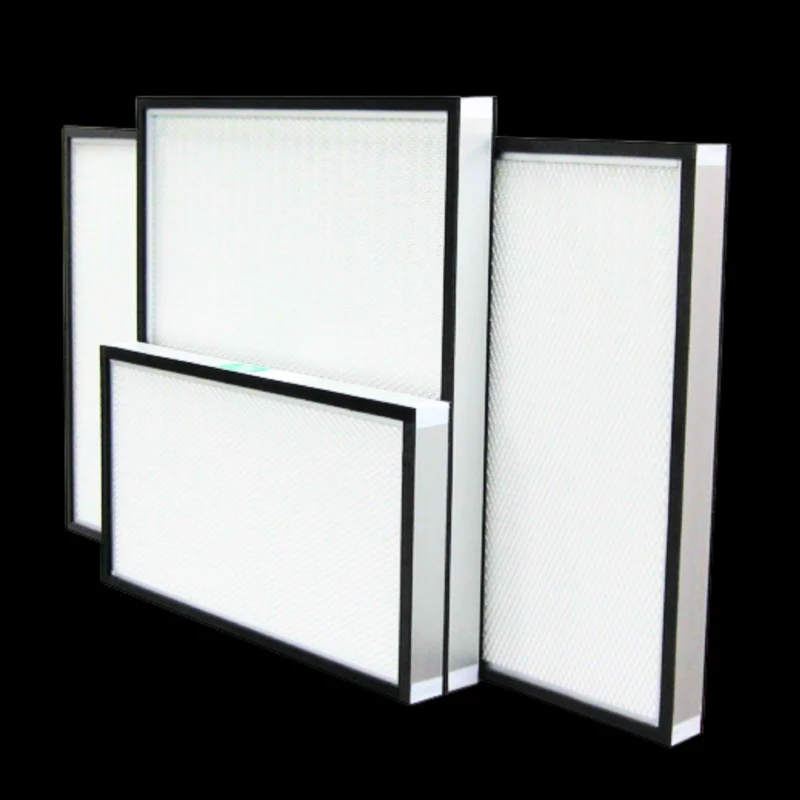
The “Ultimate Defense” of Cleanrooms: A Data-Driven Guide to Selecting HEPA Filters
This guide provides a systematic, data-driven approach to selecting HEPA filters for cleanroom applications. From determining filtration requirements by ISO Class 1–9 to evaluating efficiency standards and lifecycle costs, it offers quantifiable parameters to help engineers and procurement managers make informed decisions that balance performance, compliance, and total cost of ownership.
- 1. Define Your Objective: Determining Filtration Requirements by ISO Class
- 2. Understanding Standards: Efficiency Grades and Test Methods
- 3. Key Performance Metrics: Resistance, Airflow, and Face Velocity
- 4. Construction and Media: Separator vs. Separatorless, and Sealing Methods
- 5. Practical Guidelines: Installation Testing and Maintenance
- Conclusion
The “Ultimate Defense” of Cleanrooms: A Data-Driven Guide to Selecting HEPA Filters
1. Define Your Objective: Determining Filtration Requirements by ISO Class
The first step is to clearly define the target cleanliness level for your cleanroom—this serves as the foundation for all subsequent calculations.
ISO 14644-1 classifies cleanrooms from ISO Class 1 to ISO Class 9. The higher the grade, the more stringent the permissible airborne particle concentration limits. For example, in an ISO Class 5 cleanroom (equivalent to the former Federal Standard 100 class), the maximum allowable particle count for particles ≥0.5 µm is 3,520 per cubic meter.
Different ISO classes require specific air supply volumes (air change rates), which directly determine the required airflow capacity of the filters. Based on industry experience, the recommended air change rates to maintain cleanliness are approximately:
| ISO Class | Equivalent FED-STD-209E | Recommended Air Changes Per Hour (ACH) |
|---|---|---|
| ISO 5 | Class 100 | Unidirectional flow, air velocity 0.2–0.5 m/s |
| ISO 6 | Class 1,000 | ~80 ACH |
| ISO 7 | Class 10,000 | ~50 ACH |
| ISO 8 | Class 100,000 | ~20 ACH |
2. Understanding Standards: Efficiency Grades and Test Methods
The “high efficiency” of HEPA filters is not a vague concept—it is precisely defined by rigorous international standards. The prevailing standards—European EN 1822 and ISO 29463—classify filters based on their Most Penetrating Particle Size (MPPS) efficiency.
Core Parameter: MPPS Efficiency
HEPA filters do not achieve their maximum efficiency at the largest particle sizes. In fact, there is a minimum efficiency point in the particle size range of approximately 0.1–0.2 µm—this is the MPPS. Professional standards classify filters precisely based on their overall and local efficiency at the MPPS.
| Grade | Overall Efficiency (MPPS) | Local Efficiency (MPPS) | Typical Applications |
|---|---|---|---|
| H13 | ≥ 99.95% | ≥ 99.75% | Pharmaceutical Grade C/D areas, general electronics cleanrooms |
| H14 | ≥ 99.995% | ≥ 99.975% | Aseptic filling lines, biological safety cabinets, ISO Class 5 environments |
| U15 | ≥ 99.9995% | ≥ 99.9975% | Semiconductor photolithography, advanced pharmaceutical isolators |
3. Key Performance Metrics: Resistance, Airflow, and Face Velocity
Choosing a filter based solely on efficiency is insufficient—physical performance parameters that impact HVAC system design must also be considered.
3.1 Initial Resistance and Final Resistance
These are critical parameters for determining filter replacement intervals and energy consumption. The initial resistance of a new HEPA filter typically ranges between 0.5 and 1.5 inches w.g. (124–373 Pa). As the filter loads with particles, resistance increases. When it reaches the final resistance of 2.0 to 3.0 inches w.g. (498–747 Pa), replacement is required. During system design, ensure that the air handling unit has sufficient static pressure margin to overcome the final resistance.
3.2 Rated Airflow and Face Velocity
Each HEPA filter has a rated airflow capacity, typically determined at a standard face velocity of 0.5 m/s. The total number of filters required is calculated based on the total supply airflow. Operation beyond the rated airflow should be avoided, as it significantly increases resistance and may compromise filtration efficiency. For terminal HEPA filters, the design face velocity is generally recommended not to exceed 0.5 m/s.
4. Construction and Media: Separator vs. Separatorless, and Sealing Methods
The physical construction of the filter determines its durability and application suitability.
4.1 Separator-Type (Pleated) Filters
These filters use aluminum foil or paper separators to maintain pleat spacing. They offer robust structural integrity, can withstand higher air velocities (up to 2.5 m/s) and temperatures (up to 120°C), and are suitable for high-airflow, high-temperature, or specialized industrial applications.
4.2 Separatorless (Mini-Pleat) Filters
These use hot-melt adhesive beads to separate the pleats. They are compact, lightweight, and exhibit lower resistance compared to separator-type filters—making them the most common choice for terminal filtration in modern cleanrooms.
4.3 Sealing Methods
Sealing is another critical aspect:
- Gasket seals are easy to install but may pose leakage risks over time due to compression set.
- Liquid/gel seals (gel seals) offer superior reliability for demanding applications (e.g., pharmaceutical manufacturing). The filter is embedded in a non-Newtonian fluid within the frame, achieving near-zero bypass leakage.
5. Practical Guidelines: Installation Testing and Maintenance
Proper selection must be complemented by correct installation and rigorous testing protocols.
5.1 In-Situ Leak Testing
Per ISO 14644-3, all installed HEPA filters must undergo leak testing. The aerosol photometer scanning method, using PAO (polyalphaolefin) or similar challenge aerosols, is the industry standard. The acceptance criterion is that the leak rate at any point on the filter face or frame seal shall not exceed 0.01% of the upstream concentration.
5.2 Testing Frequency
During normal operation, HEPA filters require periodic re-certification. As a general guideline:
- Every 12 months for most applications.
- Every 6 months for ISO Class 5 and higher environments.
5.3 Spare Filter Strategy
Due to potential damage during transportation and installation, a certain percentage of on-site filters will inevitably fail leak testing. A prudent procurement strategy is to reserve at least 20% spare filters to avoid project delays.
Conclusion
Selecting the right HEPA filter is ultimately a process of quantitatively aligning cleanroom classification requirements (ISO Class) with filter efficiency grade (e.g., H13/H14), airflow/resistance performance (face velocity ≤0.5 m/s, initial/final resistance values), while simultaneously accounting for construction (separator vs. separatorless), sealing (gasket vs. gel seal), and rigorous field testing (≤0.01% leak rate). This integrated approach ensures a reliable, compliant, and economically optimized cleanroom environment.
Final Checklist for HEPA Filter Selection
| Criterion | Target / Specification |
|---|---|
| ISO Cleanliness Class | Define target class (e.g., ISO 5) |
| Efficiency Grade | H13 / H14 / U15 based on application |
| Face Velocity | ≤ 0.5 m/s (terminal) |
| Initial Resistance | ≤ 220 Pa (typical for 610×610×69mm @ rated flow) |
| Final Resistance | 2.0–3.0 in.w.g. (498–747 Pa) for replacement |
| Construction | Separatorless preferred; separator-type for harsh conditions |
| Seal Type | Gel seal for critical applications; gasket for general use |
| In-Situ Leak Rate | ≤ 0.01% of upstream concentration |
| Spare Stock | ≥ 20% of total quantity |
Please login to write a comment after