 English
 Español
 Français
 Italiano
 Deutsch
 日本語
 Русский
 العربية
 Português
 Svenska

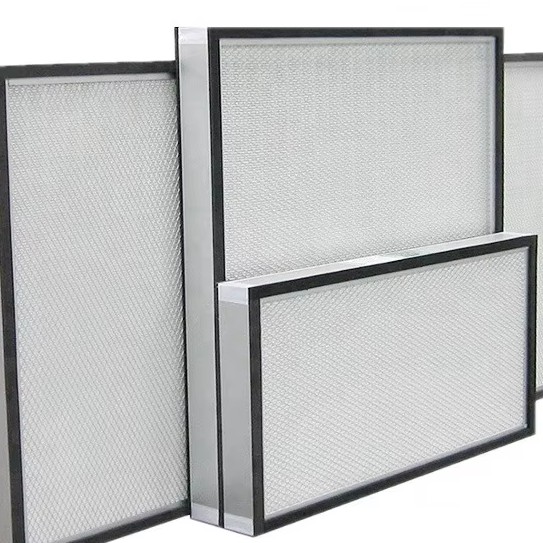
HEPA vs. ULPA Filters: A Comprehensive Data-Driven Comparison for Cleanroom Selection
HEPA and ULPA filters both safeguard air quality in controlled environments, yet differ significantly in efficiency, testing standards, applications, and system costs. This data-driven comparison examines their efficiency ratings—HEPA achieving ≥99.97% at 0.3 μm per JIS B 9927 while ULPA requires ≥99.999% at 0.12 μm—along with pressure drop, energy consumption, and lifespan considerations. Designed for cleanroom engineers and facility planners, this guide supports informed filter selection by analyzing performance parameters, certification protocols, and industry-specific requirements.
HEPA vs. ULPA Filters: A Comprehensive Data-Driven Comparison for Cleanroom Selection
1. Definitions and Core Efficiency Metrics
1.1 HEPA Filters
HEPA (High Efficiency Particulate Air) filters are the most widely used high-efficiency filters in cleanroom applications. According to the JIS B 9927 standard (which aligns with ISO 29463), a HEPA filter is defined as one that achieves a collection efficiency of 99.97% or higher for 0.3 μm particles at rated airflow, with an initial pressure drop of 253 Pa or less. Conventional Japanese HEPA filters (99.97% efficiency at 0.3 μm) can be classified as ISO E30 grade (EPA filter group) within the ISO framework.
In tests targeting nanoparticles, HEPA filters also demonstrate excellent performance. A systematic review study indicated that HEPA filters achieve > 99.99% filtration efficiency for nanomaterials, a performance underpinned by the physical mechanism of Brownian diffusion.
1.2 ULPA Filters
ULPA (Ultra Low Penetration Air) filters represent an “upgraded” version of HEPA, offering higher capture efficiency for smaller particle sizes. By definition, ULPA filters must achieve a collection efficiency of 99.999% or higher for 0.12 μm particles. Recent industry standards have further refined ULPA classifications, with filter efficiency ranges spanning from 99.95% to 99.999995% across different grades.
For example, according to product specifications from a leading filter media manufacturer, their ULPA series media can achieve penetration rates as low as 0.000004% to 0.002% for 0.18 μm particles, corresponding to efficiencies as high as 99.999996% to 99.998%.
2. Comparative Efficiency Data
2.1 Laboratory Test Data
A performance evaluation study of HEPA and ULPA filters conducted at an Australian animal health laboratory provides highly valuable empirical data:
| Test Parameter | HEPA Filter | ULPA Filter |
|---|---|---|
| Challenge Aerosol | Dry polydisperse NaCl (count median diameter: 60 nm) | Same as left |
| Test Airflow Rate | 472 L/s | Same as left |
| Overall Efficiency | ~99.999957% | ~99.9999990% |
Under identical test conditions, the ULPA filter demonstrated an efficiency two orders of magnitude higher than that of the HEPA filter.
2.2 Performance Differences in Series Configurations
The same study also tested the performance of the two filter types in series configurations:
- When a HEPA and a ULPA were placed in series, the penetration rate was only one-quarter of that of a standalone ULPA.
- The series penetration rate was less than 1/200th of that of a standalone HEPA.
This indicates that even in the highest-level biosafety laboratories (e.g., BSL-4), redundant multi-stage HEPA configurations can meet stringent requirements without necessarily employing ULPA filters, while offering generally more predictable total lifecycle costs.
3. Testing Standards and Classification Systems
3.1 ISO 29463 Framework
The current internationally recognized classification standard for high-efficiency filters is ISO 29463 (EN 1822 in Europe), which classifies filters based on their Most Penetrating Particle Size (MPPS). The testing process includes three key stages:
- Media Efficiency Test: Determines the efficiency at various particle sizes under rated airflow to identify the MPPS.
- Scanning Leak Test: Uses MPPS challenge particles to scan the filter surface point-by-point, assessing local efficiency.
- Overall Efficiency Test: Determines the filter’s overall efficiency rating.
3.2 Key Difference: Test Particle Size
The fundamental difference between HEPA and ULPA lies in their reference test particle sizes:
- The MPPS for HEPA filters is typically in the 0.3 μm range.
- The MPPS for ULPA filters falls within the 0.1–0.2 μm range.
For membrane media filters with an MPPS below 0.1 μm, testing methodologies are still being refined within the current standards framework.
4. Application Scenarios and Cleanliness Classes
4.1 Cleanroom Grade Comparison
Taking biological safety cabinets as an example, the installation of different filter grades results in markedly different operational area cleanliness levels:
| Filter Type | Achievable Cleanliness Class | Equivalent FED-STD-209E |
|---|---|---|
| HEPA | ISO Class 5 | Class 100 |
| ULPA | ISO Class 3 | Class 1 |
ISO Class 3 cleanrooms have extremely low allowable concentrations for particles ≥0.1 μm, making them an essential requirement for advanced processes such as semiconductor photolithography.
4.2 Typical Application Fields
- HEPA Application Scenarios: Pharmaceutical manufacturing (Grade C/D areas), hospital operating rooms, biological safety cabinets, general electronics cleanrooms, food processing.
- ULPA Application Scenarios: Semiconductor wafer fabrication, photolithography processes, nanotechnology research, advanced pharmaceutical isolators, ISO Class 3 and higher cleanrooms.
5. System Design Implications: Resistance and Energy Consumption
5.1 Pressure Drop Differences
The higher filtration efficiency of ULPA filters comes from a more compact filter media structure, which directly results in a significantly higher initial resistance compared to HEPA filters. At equivalent airflow rates, ULPA filters require more powerful fans to overcome the higher resistance, placing greater demands on the HVAC system’s static pressure capacity.
5.2 Total Lifecycle Cost Considerations
ULPA filters not only carry higher initial procurement costs but also incur greater operational energy expenses:
- Higher Fan Power Requirements: Fan power must be increased to overcome the higher resistance of ULPA filters.
- More Frequent Replacement: Under high-resistance operating conditions, filters may reach their final resistance threshold sooner.
- More Expensive Maintenance: ULPA filter element replacement and disposal costs are generally higher than those for HEPA filters.
For budget-constrained projects, lifecycle cost analyses consistently show that redundant HEPA systems offer more predictable and controllable total costs compared to single-stage ULPA systems.
6. Selection Recommendations
Choosing between HEPA and ULPA is ultimately a decision that quantitatively aligns cleanliness requirements with system investment:
- Cleanliness Class is the Primary Determinant: If the target is ISO Class 5 (Class 100) or lower, HEPA filters are sufficient. If ISO Class 3 (Class 1) or higher is required, ULPA filters are mandatory.
- Industry Regulations Define the Minimum: Pharmaceutical aseptic production (Grade A/B) requires H14-grade HEPA filters, while advanced semiconductor manufacturing mandates ULPA-grade filtration.
- Beyond the “HEPA or ULPA” Binary: For extreme biosafety applications (e.g., BSL-4), redundant multi-stage HEPA configurations are an accepted solution under many international guidelines, often offering superior reliability and economy compared to single-stage ULPA.
- Comprehensive Total Cost Assessment: Selection should incorporate initial capital investment, incremental energy consumption, and maintenance/replacement frequency into a unified evaluation model, rather than focusing solely on the purchase price of individual filters.
Quick Reference Comparison Table
| Characteristic | HEPA Filter | ULPA Filter |
|---|---|---|
| Efficiency Standard | ≥ 99.97% for 0.3 μm particles | ≥ 99.999% for 0.12 μm particles |
| MPPS Test Range | ~0.3 μm | 0.1–0.2 μm |
| Achievable Cleanliness | ISO Class 5 (Class 100) | ISO Class 3 (Class 1) |
| Initial Resistance | ≤ 253 Pa (typical) | Significantly higher than HEPA |
| Typical Applications | Pharmaceuticals, hospitals, general electronics, biosafety cabinets | Semiconductor lithography, nanotechnology, advanced isolators, ISO Class 3+ |
| Relative Cost | Lower | Higher (procurement + operation) |
Please login to write a comment after