 English
 Español
 Français
 Italiano
 Deutsch
 日本語
 Русский
 العربية
 Português
 Svenska

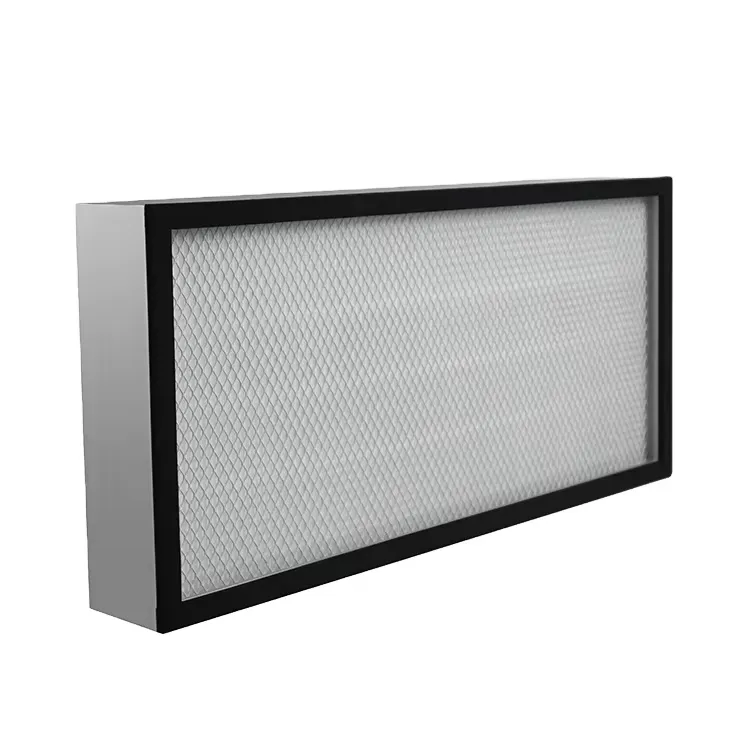
Everything You Need to Know About HEPA Filters: Principles, Standards, and Data-Driven Insights
HEPA filters capture particles via four mechanisms—interception, impaction, diffusion, settling—not sieving. Efficiency is lowest at MPPS, typically 0.1–0.3 μm.
- 1. Core Principle: Why HEPA Is Not a “Sieve”
- 2. Critical Parameters and Data: The Hard Numbers That Define HEPA
- 2.1 The Significance of “0.3 Microns”
- 2.2 Efficiency Thresholds and HEPA Grades (EN 1822 / ISO 29463)
- 2.3 Pressure Drop and Airflow – The Often-Overlooked Tradeoff
- 3. Practical Selection: Residential vs. Professional Applications
- 3.1 For Home Air Purifiers: H13 Is Now Mainstream
- 3.2 Medical and Industrial Cleanrooms: Sealing and Integrity Matter More
- 3.3 Composite Filters: HEPA + Activated Carbon
- 4. Summary: A Data-Driven Checklist for HEPA Selection
- Final Thought
Everything You Need to Know About HEPA Filters: Principles, Standards, and Data-Driven Insights
HEPA – High-Efficiency Particulate Air – is one of the most critical technologies for indoor air quality. From hospital operating rooms and pharmaceutical cleanrooms to home air purifiers and vacuum cleaners, HEPA filters are the gold standard for particle removal. But HEPA is far more than a simple mesh. Behind it lies a rigorous scientific framework, supported by clearly defined standards and measurable parameters. This article provides a comprehensive, data-backed guide to HEPA filters – how they work, how they are rated, what numbers really matter, and how to choose the right one for your needs.
1. Core Principle: Why HEPA Is Not a “Sieve”
Many people mistakenly believe that HEPA filters trap particles simply because their pores are small enough to block them – like a strainer. In reality, HEPA media consists of randomly arranged ultra-fine glass fibers or polypropylene microfibers, forming a three-dimensional tortuous pathway. Particle capture relies on a combination of four physical mechanisms, not simple size exclusion:
- Interception: Particles following the airflow come into direct contact with a fiber and are captured.
- Inertial Impaction: Larger particles (e.g., >1 μm) possess greater inertia; when airflow diverts around a fiber, these particles cannot follow the streamlines and collide with the fiber surface.
- Diffusion: Ultrafine particles (<0.1 μm) are subjected to Brownian motion, which increases their random movement and the probability of colliding with fibers.
- Gravitational Settling: Larger, denser particles may settle onto fibers under gravity.
Because these mechanisms operate most weakly at a specific particle size, every HEPA filter has a Most Penetrating Particle Size (MPPS) – the size at which the filter achieves its lowest filtration efficiency.
2. Critical Parameters and Data: The Hard Numbers That Define HEPA
2.1 The Significance of “0.3 Microns”
For HEPA testing, 0.3 μm is the reference particle size. Why? Because 0.3 μm sits at the transition zone between diffusion-dominated (smaller particles) and interception/impaction-dominated (larger particles) regimes. At this size, all capture mechanisms are at their weakest, making it the MPPS for most HEPA media. Crucially, if a filter achieves high efficiency at 0.3 μm, it will perform even better against both larger and smaller particles – a counterintuitive but well-established fact.
2.2 Efficiency Thresholds and HEPA Grades (EN 1822 / ISO 29463)
The most authoritative classification system comes from the European standard EN 1822 (now gradually superseded by ISO 29463, but the grading remains widely used). This standard classifies filters based on their MPPS efficiency – not just overall particle count, but the worst-case efficiency.
| Grade | MPPS Filtration Efficiency (at ~0.3 μm) | Typical Application |
|---|---|---|
| E10 – E12 | 85% – 99.5% | Sub-HEPA / coarse fine filtration |
| H13 | ≥ 99.95% | Medical-grade, high-end residential air purifiers |
| H14 | ≥ 99.995% | Cleanrooms, pharmaceutical production, high-level bio-containment |
| U15 – U17 | 99.9995% – 99.999995% | ULPA (Ultra-Low Penetration Air), semiconductor manufacturing |
Key threshold to remember: Under EN 1822, a filter is not considered true HEPA unless it achieves at least 99.95% efficiency at the MPPS. In practice, the widely cited H13 grade corresponds to ≥ 99.97% at 0.3 μm, and typically achieves > 99.99% at 0.1 μm. The U.S. DOE standard likewise defines the HEPA entry threshold as ≥ 99.97% for 0.3 μm particles.
2.3 Pressure Drop and Airflow – The Often-Overlooked Tradeoff
High filtration efficiency almost always comes at the cost of higher airflow resistance. This is a critical design parameter that affects both energy consumption and fan sizing.
- Initial Pressure Drop (Initial Resistance): The resistance of a new, clean filter. For example, a typical H13–H14 grade filter with an area of ~7.5 m² and rated airflow of 800 m³/h exhibits an initial pressure drop of approximately 220 Pa at 0.5 m/s face velocity. In the U.S. VA hospital procurement standards, the initial resistance at rated airflow must not exceed 1.0 inch water gauge (≈ 249 Pa).
- Final Pressure Drop (Final Resistance): This is the resistance when the filter is loaded with captured particles and needs replacement. It is usually set at 2× the initial resistance. For instance, if the initial drop is 180 Pa, the recommended final resistance would be around 360 Pa. Exceeding this value may cause bypass leakage, reduced airflow, and increased fan energy.
- Dust-Holding Capacity: A standard 610×610×50 mm H13–H14 filter with 7.5 m² media area has a dust-holding capacity of about 450 grams (using ASHRAE test dust) before reaching final resistance.
3. Practical Selection: Residential vs. Professional Applications
3.1 For Home Air Purifiers: H13 Is Now Mainstream
In the consumer market, H13-grade HEPA has become the de facto standard for mid-to-high-end air purifiers. It effectively captures pollen, dust mite feces, mold spores, and even many airborne bacteria and virus-carrying droplets. Some premium brands now adopt H14 media or proprietary technologies like HyperHEPA, claiming ≥ 99.5% efficiency at 0.003 μm – well into the nanoparticle range – though such claims should be verified against independent test reports.
However, a high-grade filter alone does not guarantee high performance. The Clean Air Delivery Rate (CADR) – which measures the volume of clean air delivered per minute – depends equally on the filter’s resistance and the fan’s airflow curve. A poorly matched fan may reduce CADR by 30–50%, rendering the high-grade filter ineffective. Always check the CADR value (in m³/h or CFM) rather than relying solely on the HEPA grade.
3.2 Medical and Industrial Cleanrooms: Sealing and Integrity Matter More
For pharmaceutical cleanrooms, operating theatres, and biosafety laboratories, filter media efficiency is only half the story. System integrity and sealing are equally critical. Bypass leakage – unfiltered air sneaking around the filter frame – can completely defeat the purpose. These applications require:
- Gel-seal or knife-edge frames to ensure zero bypass.
- DOP (Di-Octyl Phthalate) or PAO (Poly-Alpha-Olefin) aerosol challenge tests to verify overall system penetration.
- Scanning with laser particle counters to detect any pinhole leaks in the media or seal.
Such environments typically demand H14 or higher, and for ISO Class 5 (Class 100) cleanrooms, final resistance is often set at 2.0–3.0 inches w.g. before replacement.
3.3 Composite Filters: HEPA + Activated Carbon
It is important to note that HEPA alone does NOT remove gases or odors – including formaldehyde, VOCs, cigarette smoke, or cooking smells. For comprehensive indoor air treatment, high-end purifiers use multi-stage filtration:
- Pre-filter for coarse dust and hair.
- HEPA media for particulate matter.
- Activated carbon bed (typically 200–500 g weight) for chemisorption of gaseous pollutants.
The carbon weight and thickness directly affect the gas removal capacity – a thin carbon sheet (e.g., < 50 g) offers negligible adsorption life.
4. Summary: A Data-Driven Checklist for HEPA Selection
When evaluating or purchasing a HEPA-based product, keep these quantifiable criteria in mind:
| Parameter | Recommended Benchmark | Why It Matters |
|---|---|---|
| HEPA Grade | At least H13 (≥ 99.97% @ 0.3 μm) | Ensures true particulate filtration efficiency. |
| Initial Pressure Drop | ≤ 250 Pa at rated airflow | Prevents excessive fan load and noise. |
| Final Resistance / Replacement | Replace when resistance reaches 2× initial or as per manufacturer’s spec | Avoids bypass leakage and energy waste. |
| CADR (for purifiers) | ≥ 4× room volume per hour | Correlates with actual clean air delivery. |
| Sealing Method | Gel-seal or gasket with compression | Prevents unfiltered air bypass. |
| For gases/VOCs | Additional activated carbon layer (≥ 200 g) | HEPA does not remove chemical pollutants. |
Final Thought
HEPA filters are not a marketing gimmick – they are precision-engineered components with clearly defined performance metrics. Understanding the numbers behind the acronym empowers you to make informed decisions, whether you are buying a home air purifier, specifying equipment for a cleanroom, or simply wanting to breathe cleaner air. When in doubt, always ask for the test report (EN 1822 or ISO 29463) – not just the marketing brochure.
Please login to write a comment after