 English
 Español
 Français
 Italiano
 Deutsch
 日本語
 Русский
 العربية
 Português
 Svenska

Introduction: A Super Filter That Is Not a “Sieve”
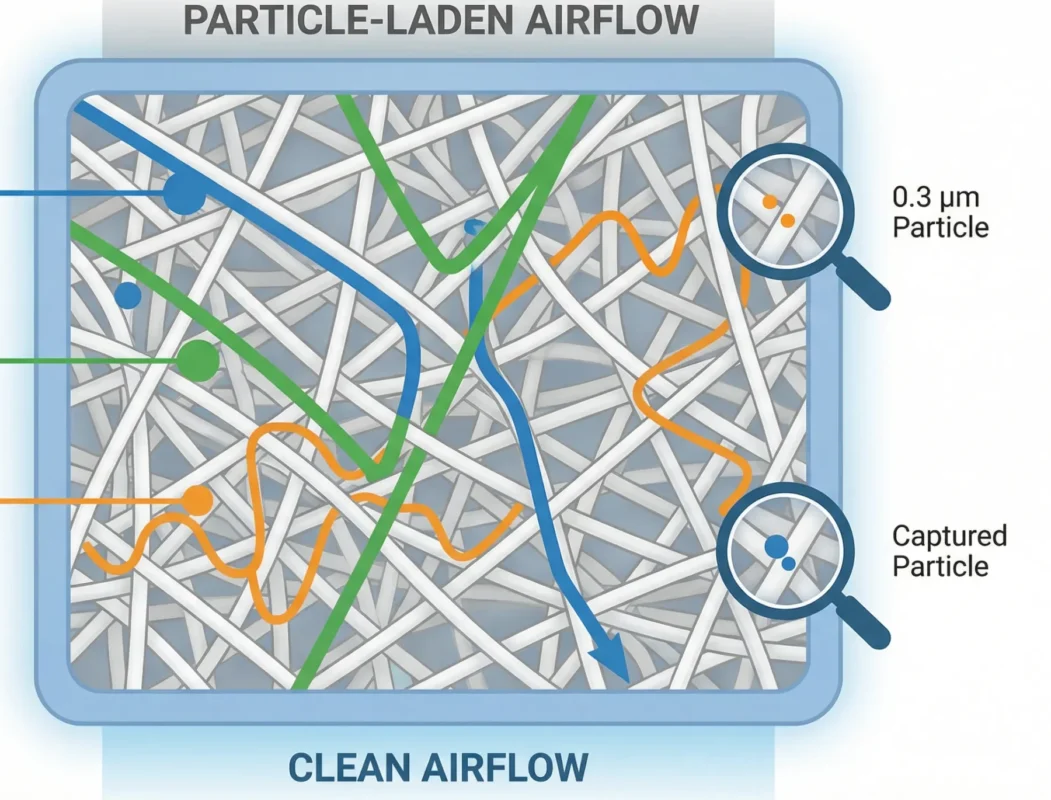
In common perception, filtration is often equated with “sieving”—if the mesh opening is smaller than the particle, the particle is blocked. However, the working principle of HEPA (High Efficiency Particulate Air) filters completely overturns this intuition. Rather than relying on a fine-mesh physical barrier, HEPA utilizes a multi-layered fiber network and principles of aerodynamics to create a “gravitational trap net” at the microscopic scale. Its ability to capture 99.97% or even 99.99% of airborne particles lies precisely in its remarkable efficiency at the most difficult-to-capture particle size range (around 0.3 μm).
1. Four Physical Mechanisms: A Synergistic Multidimensional Strategy
HEPA filters are composed of randomly intertwined glass fibers or synthetic fibers, typically ranging from 0.5 to 5 micrometers in diameter. The gaps between fibers are far larger than the target particles. The high efficiency originates from the synergistic effect of four physical mechanisms:
- Interception: When larger particles (typically >0.3 μm) travel along flow streamlines, they are physically intercepted if the particle’s radius approaches the fiber surface within a distance smaller than its radius. This is the most intuitive capture mode.
- Inertial Impaction: For particles between 0.3 and 1 μm, their greater mass endows them with higher inertia. As airflow diverts around a fiber, these particles cannot follow the sharp turn of the streamlines due to inertia, thus deviating from the flow path and directly impacting onto the fiber surface. Higher airflow velocities enhance this effect.
- Diffusion: This is the decisive mechanism for ultrafine particles (<0.1 μm). At the nanoscale, asymmetric collisions from gas molecules cause particles to undergo erratic, random movements known as Brownian motion. This intense and disordered trembling dramatically increases the probability of particle-fiber collisions, which are then captured by van der Waals forces. The smaller the particle, the more intense the Brownian motion and the stronger the diffusion effect—this is the counterintuitive phenomenon where smaller particles are actually captured more easily.
- Gravitational Settling: For some particles with higher density or larger size, gravitational forces cause them to settle naturally during passage through the filter, where they are captured by fibers in the lower layers. This effect contributes modestly at low airflow velocities.
2. MPPS (Most Penetrating Particle Size): The “Achilles’ Heel” at 0.3 Micrometers
Why do all HEPA standards focus specifically on “0.3 micrometers”? This introduces the core concept in aerosol filtration science—MPPS (Most Penetrating Particle Size).
As illustrated above, the overall efficiency curve of a HEPA filter exhibits a “U-shaped” or “V-shaped” characteristic:
- Particles >0.3 μm: Interception and inertial impaction dominate, with efficiency rising sharply as particle size increases.
- Particles <0.3 μm: Diffusion takes over as the dominant mechanism; the smaller the particle, the stronger the Brownian motion, and efficiency likewise climbs rapidly.
- Particles ≈0.3 μm: This is a “critical valley”—neither interception/inertial impaction nor diffusion is sufficiently strong, leaving all three mechanisms at a relatively weak state, resulting in peak penetration.
Therefore, global HEPA testing standards (such as the U.S. DOE and European EN 1822) uniformly stipulate: the 0.3 μm particle size is used as the most stringent challenge. If a filter achieves 99.97% efficiency at this size, it guarantees that at all other sizes—whether smaller or larger—the efficiency will be even higher.
3. Efficiency Classification and Performance Parameters: What Grade Does 99.99% Actually Correspond To?
“99.99%” is not a vague figure; it corresponds to a specific international standard grade. According to the European EN 1822 (now gradually superseded by ISO 29463) classification system, HEPA filters are categorized into multiple grades based on integral efficiency (overall average efficiency) and local efficiency (point-by-point scan efficiency) :
| Grade | Integral Efficiency (at MPPS) | Local Efficiency (Scan Leak Test) | Typical Applications |
|---|---|---|---|
| H10 | ≥ 85% | — | General clean air conditioning |
| H11 | ≥ 95% | — | Food processing, general cleanrooms |
| H12 | ≥ 99.5% | — | Pharmaceutical workshops, fine chemicals |
| H13 | ≥ 99.95% | ≥ 99.75% | Hospital operating rooms, semiconductor manufacturing |
| H14 | ≥ 99.995% | ≥ 99.975% | Nuclear industry containment, biosafety cabinets |
| U15 | ≥ 99.9995% | ≥ 99.9975% | Nanotechnology, photolithography processes |
When a product claims “99.99% filtration efficiency,” its technical grade typically reaches at least H13 (≥99.95%). If it passes the scanning test, it may be closer to H14 level. This means that at the most penetrating particle size of 0.3 μm, fewer than 10 particles out of every 100,000 pass through the filter.
4. Velocity-Dependent Efficiency: The Impact of Operating Conditions
Efficiency is not a fixed constant; the actual face velocity (airflow speed through the filter) significantly influences the contribution weights of each mechanism. The following test data (based on relevant research) clearly demonstrates the efficiency variations across particle sizes at different airflow velocities:
| Particle Size (μm) | Efficiency at 0.5 m/s (%) | Efficiency at 1.5 m/s (%) | Efficiency at 3.0 m/s (%) |
|---|---|---|---|
| 0.03 | 99.97 | 99.85 | 99.71 |
| 0.05 | 99.84 | 99.40 | 99.17 |
| 0.08 | 99.85 | 99.56 | 99.27 |
| 0.10 | 99.88 | 99.66 | 99.37 |
| 0.15 | 99.96 | 99.87 | 99.78 |
| 0.20 | 99.995 | 99.97 | 99.92 |
| 0.30 | 99.9991 | 99.990 | 99.970 |
| 0.40 | 99.9994 | 99.995 | 99.984 |
| 0.50 | — | — | 99.83 |
Key Conclusions:
- At all tested velocities, the lowest efficiency consistently occurs in the 0.1–0.3 μm range, confirming the objective existence of MPPS.
- Lower airflow velocity yields higher overall filtration efficiency, especially in the submicron range dominated by diffusion, where lower speeds allow more residence time for Brownian motion, significantly increasing capture probability.
- Higher velocities, while enhancing inertial impaction, weaken the diffusion effect and simultaneously increase pressure drop and energy consumption.
5. Deep-Bed Filtration: The Logic of Dust Holding Beyond Surface Clogging
HEPA filters belong to deep-bed filtration media, with a thickness typically ranging from tens to hundreds of micrometers, composed of multi-layered structures. Particles are not merely intercepted on the filter surface but are captured progressively throughout the depth of the fiber layer. This design endows HEPA filters with two major advantages:
- High Dust-Holding Capacity: Particles are distributed along the depth direction, preventing rapid surface clogging and thereby extending service life.
- Stability: Even if some surface fibers are covered by larger particles, the deeper layers continue to maintain efficient submicron particle capture capability.
Conclusion: Precision Physics, Not Magic
The reason HEPA filters can achieve 99.99% particle filtration efficiency lies in their ingenious utilization of four physical mechanisms, each dominating at different particle size ranges, while setting a rigorous benchmark at the weakest point—the 0.3 μm MPPS. From interception and impaction to diffusion, and from standardized classification to real-world velocity considerations, every aspect is grounded in solid aerodynamics and materials science. Understanding these principles not only helps us select appropriate HEPA products but also dispels the misconception that “smaller pores are always better,” enabling a scientifically informed perspective on the true performance of air purification technologies.
Please login to write a comment after