 English
 Español
 Français
 Italiano
 Deutsch
 日本語
 Русский
 العربية
 Português
 Svenska

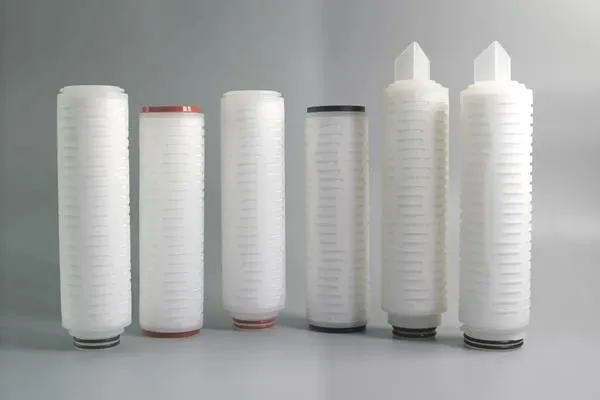
Hydrophilic vs. Hydrophobic PTFE Pleated Filter Cartridges: Principles, Specifications, and Applications
PTFE pleated filter cartridges are classified by surface energy into hydrophobic (water contact angle ~132°) for gas/air filtration and hydrophilic (<43°) for aqueous filtration. Hydrophilic types are achieved via -OH/-COOH grafting, enabling water flow while retaining PTFE's chemical resistance. This article compares material principles, specifications, and ideal applications across pharma, microelectronics, and chemical industries.
- 1. Material Science Foundation: From Intrinsic Hydrophobicity to Hydrophilic Modification
- 2. Comprehensive Performance Parameter Comparison
- 2.1 Filtration Rating and Retention Efficiency
- 2.2 Integrity Test Data (Bubble Point and Diffusion Flow)
- 2.3 Flow Rate and Differential Pressure Characteristics
- 2.4 Extractables and Biosafety Compliance
- 3. Application Guidelines and Technical Selection Criteria
- 4. Conclusion
Hydrophilic vs. Hydrophobic PTFE Pleated Filter Cartridges: Principles, Specifications, and Applications
Polytetrafluoroethylene (PTFE) pleated filter cartridges are widely recognized for their exceptional chemical resistance and high filtration efficiency, making them indispensable in pharmaceutical, microelectronics, chemical processing, and food & beverage industries. The functional classification—hydrophilic versus hydrophobic—is governed by the surface characteristics of the PTFE microporous membrane, which in turn dictates their specific application fields. This article provides a comprehensive technical analysis based on material science principles and validated performance parameters.
1. Material Science Foundation: From Intrinsic Hydrophobicity to Hydrophilic Modification
The intrinsic chemical structure of PTFE endows it with an extremely low surface free energy. Untreated PTFE membranes exhibit a static water contact angle of approximately 132°, demonstrating a pronounced hydrophobic nature. This property makes them highly resistant to water penetration and ideally suited for gas-phase filtration.
To enable liquid (especially aqueous) filtration, the PTFE membrane must undergo hydrophilic modification. The mainstream industrial approach employs a post-treatment physical coating process, where hydrophilic functional groups (such as -OH and -COOH) are grafted onto the PTFE fibril structure via an “entanglement” mechanism. This alteration effectively increases the surface tension. After high-efficiency modification, the static water contact angle of flat-sheet PTFE microporous membranes can be significantly reduced from 132° to below 43°, enabling spontaneous wetting by water and allowing aqueous fluid passage.
| Parameter | Hydrophobic PTFE Cartridge | Hydrophilic PTFE Cartridge |
|---|---|---|
| Core Characteristic | Intrinsically hydrophobic; contact angle ~132° | Modified surface; contact angle <43° |
| Gas Filtration Rating | Down to 0.01 µm absolute (retains phages) | Not applicable for gas sterilization |
| Liquid Filtration Rating | Typically for aggressive solvents | 0.10 µm – 0.65 µm (conventional grades) |
| Bubble Point Reference | 0.2 µm pore size ≥0.09 MPa (60% IPA) | 0.22 µm pore size ≥0.9 bar (60% IPA) |
| Primary Applications | Tank vents, compressed air sterilization, fermentation aeration | Corrosive liquids, aqueous chemicals, electrolyte filtration |
2. Comprehensive Performance Parameter Comparison
2.1 Filtration Rating and Retention Efficiency
- Hydrophobic Cartridges: They deliver outstanding performance in gas filtration, with absolute retention ratings down to 0.01 µm, ensuring 100% retention of bacteria and bacteriophages. This efficacy is maintained under humid conditions, as the hydrophobic surface prevents water vapor from blocking the pores (liquid bridging).
- Hydrophilic Cartridges: They are primarily designed for liquid sterilization, with standard absolute ratings of 0.10 µm, 0.22 µm, and 0.45 µm depending on the application.
2.2 Integrity Test Data (Bubble Point and Diffusion Flow)
Integrity testing is critical for validating cartridge performance. For a standard 10-inch (10″) cartridge configuration, using 60% Isopropanol (IPA) as the test fluid, typical bubble point values are specified as follows:
- 0.10 µm Pore Size: Bubble point ≥ 0.12 MPa (high-end hydrophilic membranes) to ≥ 1.2 bar (industrial grade).
- 0.20/0.22 µm Pore Size: Bubble point ≥ 0.09 MPa (hydrophobic) and ≥ 0.08 MPa (hydrophilic).
- 0.45 µm Pore Size: Bubble point ≥ 0.04 MPa.
2.3 Flow Rate and Differential Pressure Characteristics
- Hydrophilic Cartridges (Water Flow Rate): A single 10-inch cartridge typically delivers a pure water flow rate of ≥6.89 L/min at a differential pressure of 0.13 MPa.
- Hydrophobic Cartridges (Air Flow Rate): A single 10-inch cartridge provides an air flow rate of ≥6 m³/min at a differential pressure of 0.13 MPa.
- Maximum Allowable Differential Pressure: For both types, the maximum forward differential pressure at 25°C is 0.42 MPa, while the maximum reverse differential pressure is 0.21 MPa.
2.4 Extractables and Biosafety Compliance
For pharmaceutical and food-grade applications, both cartridge types must strictly control extractable levels. Standard requirements stipulate that total extractables for a 10-inch cartridge should be below 0.03 grams, and endotoxin levels must be less than 0.25 EU/ml, ensuring full compliance with biosafety standards.
3. Application Guidelines and Technical Selection Criteria
The selection between hydrophilic and hydrophobic PTFE cartridges should strictly adhere to the principle of “matching the surface property to the process fluid”:
- Select Hydrophobic PTFE Cartridges for:
- Tank Venting (Respirators): Used for WFI (Water for Injection) storage tanks and fermenter inlet/outlet vents to prevent microbial ingress while permitting free gas exchange.
- Compressed Air and Gas Sterilization: Employed in sterile packaging gas and instrument air systems, leveraging the “gas-permeable, water-impermeable” barrier property for bacteria retention.
- Select Hydrophilic PTFE Cartridges for:
- Corrosive Liquid Filtration: Such as strong acids, strong alkalis, and oxidizing fluids. Given PTFE’s broad chemical compatibility (pH range 1–14), hydrophilic modification is the optimal choice for such demanding liquid applications.
- Organic Solvents and Aqueous Chemical Baths: Including electrolytes, photoresists, and developers used in semiconductor manufacturing.
4. Conclusion
The distinction between hydrophilic and hydrophobic PTFE pleated cartridges is fundamentally a tailored manipulation of material surface energy. While hydrophobic versions leverage the native PTFE properties to excel in sterile gas filtration, hydrophilic versions transcend the material’s natural limitation against water, successfully extending its robust chemical resistance to the domain of fine liquid processing. In practical operations, referencing the bubble point values, flow rate data, and temperature/pressure resistance specifications provided above is essential to ensure optimal cartridge selection and compliant filtration process design.
Please login to write a comment after