 English
 Español
 Français
 Italiano
 Deutsch
 日本語
 Русский
 العربية
 Português
 Svenska

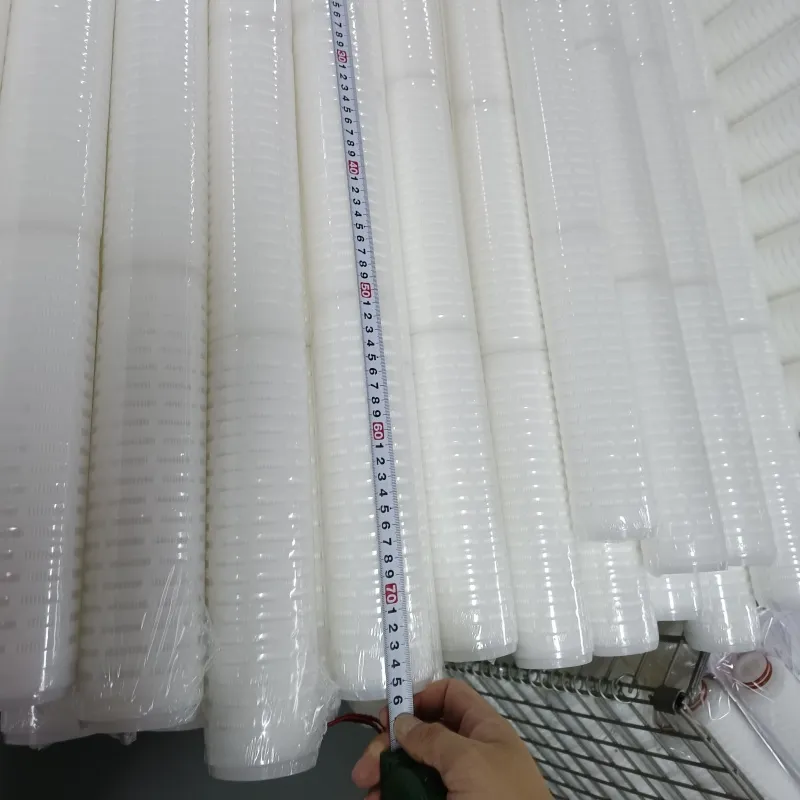
A Comprehensive Guide to High Flow Water Filter Cartridges: From Structure and Principles to Selection Parameters
This guide covers high flow water filter cartridges, including their 6-inch coreless structure, pleated design, and industrial filtration roles.
A Comprehensive Guide to High Flow Water Filter Cartridges: From Structure and Principles to Selection Parameters
High flow water filter cartridges are indispensable core filtration components in industrial water treatment systems, particularly in reverse osmosis pretreatment, seawater desalination, power plant condensate polishing, and petrochemical applications. Compared with traditional 2.5-inch standard filter cartridges, high flow cartridges achieve a several-dozen-fold increase in single-cartridge throughput through structural innovation, fundamentally changing the design logic of large-scale filtration systems. This article provides a systematic introduction to high flow water filter cartridges from multiple dimensions, including structural principles, material systems, core parameters, performance comparisons, and selection considerations.
I. What Are High Flow Water Filter Cartridges
High Flow Filter Cartridges, also known as high-throughput filter cartridges or high flow pleated filter cartridges, are deep filtration elements specifically designed for high-flow or high-contaminant-load applications. Their most distinctive external feature is the large 6-inch (152.4 mm) diameter design, along with the elimination of the traditional central support core.
In terms of structure, high flow filter cartridges adopt a single-open-end configuration with one end open and the other closed. The filtered fluid enters from the outside of the cartridge and flows out from the inside, or flows in the opposite direction, depending on the specific model design. Pall’s Ultipleat series, for example, uses an “inside-out” flow pattern, allowing all contaminants to be trapped inside the cartridge.
The direct effect of this structural innovation is that a single high flow filter cartridge can handle 70 tons per hour or even more, equivalent to the total capacity of 30 traditional 2.5-inch × 40-inch cartridges. For large-scale water treatment systems, this means the filter housing size can be reduced by more than 50%, the number of cartridges required is dramatically decreased, and the corresponding equipment investment and manual maintenance costs are significantly lowered.
II. Core Technical Parameter System
The technical parameters of high flow filter cartridges involve multiple dimensions, including size specifications, filtration accuracy, operating conditions, and flow performance. These are examined one by one below.
2.1 Size Specifications
The outer diameter of high flow filter cartridges is uniformly 152.4 mm (6 inches), which is their core identifying feature distinguishing them from other cartridges. Three standard length specifications are available:
| Nominal Length | Imperial Designation | Actual Length (approx.) |
|---|---|---|
| 508 mm | 20 inches | approx. 508–528 mm |
| 1016 mm | 40 inches | approx. 1016–1022 mm |
| 1524 mm | 60 inches | approx. 1524–1538 mm |
The three length specifications correspond to different flow handling capacities, and users can select according to system flow requirements. Some manufacturers also offer an intermediate 30-inch (762 mm) specification.
2.2 Filtration Accuracy
The filtration accuracy of high flow filter cartridges covers a wide range, from 0.5 μm to 100 μm, depending on the filter media type and manufacturing process. Common accuracy grades include:
- Fine filtration: 0.5 μm, 1 μm, 3 μm, 5 μm
- Medium filtration: 10 μm, 15 μm, 20 μm, 25 μm
- Coarse filtration: 40 μm, 70 μm, 100 μm
It should be noted that filtration accuracy is classified into two nominal categories: “nominal accuracy” and “absolute accuracy.” Taking Feifilter’s GIGFLOW GAF series as an example, its claimed “absolute filtration accuracy > 99.9%” means that the retention efficiency for particles of a specific size is strictly guaranteed. Most general-purpose products, however, are labeled with nominal accuracy, where actual retention efficiency typically ranges from 90% to 95%.
The Pall Nexis series provides more detailed efficiency grading data: the Y100 grade has a 99.9% retention efficiency for 9.2 μm particles, Y150 corresponds to 16.0 μm, Y400 to 38.3 μm, Y750 to 73.3 μm (99.5%), and Y1000 achieves 90% retention efficiency for particles larger than 100 μm.
2.3 Operating Conditions
Operating temperature and pressure are key parameters that must be considered during selection, as they directly relate to cartridge service life and safety.
Maximum operating temperature varies by filter media:
- Melt-blown polypropylene (PP): 65°C
- Pleated polypropylene: 82°C
- Glass fiber (GF): 120–121°C
- High-temperature type (HT): 120°C
Maximum operating differential pressure is typically in the range of 2.9–3.43 bar (approximately 42–50 psi). The recommended replacement differential pressure is generally 2.4 bar (35 psi). When the cartridge differential pressure reaches this value, it indicates that the contaminant holding capacity is approaching saturation, and the cartridge should be replaced promptly to avoid insufficient flow or cartridge damage.
2.4 Flow Performance
Flow performance is the core advantage of high flow filter cartridges. The recommended water flow rates for different length specifications are as follows (using 40 inches as an example):
| Length Specification | Recommended Water Flow | Equivalent LPM |
|---|---|---|
| 20 inches | 30–33 m³/h | approx. 660 LPM |
| 40 inches | 50–60 m³/h | approx. 1300 LPM |
| 60 inches | 80–110 m³/h | approx. 1900 LPM |
The above data represent recommended values under typical operating conditions. Actual flow capacity is affected by filtration accuracy, feed water quality, allowable pressure drop, and other factors. The lower the accuracy and the cleaner the feed water, the greater the flow rate a single cartridge can handle. According to Pall data, its high flow filter cartridges can achieve a single-cartridge water flow rate of up to 110 m³/h.
III. Main Material Systems
The performance of high flow filter cartridges depends largely on the choice of filter media. The current mainstream filter media systems include the following three categories:
3.1 Polypropylene (PP) System
Polypropylene is the most commonly used material for high flow filter cartridges, including both pleated deep polypropylene and melt-blown polypropylene forms. PP filter media offer excellent chemical compatibility and can withstand corrosion from strong acids, strong bases, and most organic solvents. Their pore structure features a graduated pore size design, with a loose outer layer and a dense inner layer, achieving deep filtration effects.
The filtration accuracy of PP cartridges typically ranges from 1 to 100 μm, with a maximum operating temperature of 82°C for pleated types and 65°C for melt-blown types. The advantages are low cost and good chemical stability; the limitation is limited temperature resistance, making them unsuitable for high-temperature applications.
3.2 Glass Fiber (GF/GT) System
The notable advantage of glass fiber filter media lies in their high-temperature resistance, with a maximum operating temperature of up to 120–121°C. Filtration accuracy covers the range of 1–25 μm, making them suitable for industrial water treatment scenarios with temperature requirements.
Glass fiber media typically offer higher filtration efficiency than PP media, but at a correspondingly higher cost. At the same time, the chemical compatibility of glass fiber is inferior to PP, and careful evaluation is required in strong alkali or certain organic solvent environments.
3.3 Support and Sealing Materials
In addition to the filter media itself, the material selection for support layers, end caps, and sealing rings also affects the overall performance of the cartridge:
- Support/drainage layer: Polypropylene non-woven fabric or mesh
- End caps: Glass fiber reinforced polypropylene
- O-ring seals: EPDM (ethylene propylene diene monomer), nitrile rubber, silicone rubber, fluororubber
Sealing ring materials must be matched according to the chemical properties of the filtered liquid. For example, EPDM offers excellent water resistance and weather resistance and is the standard choice for water treatment applications; fluororubber (Viton) is suitable for a broader range of chemical environments but at a higher cost.
IV. Performance Comparison: High Flow Cartridges vs. Traditional Cartridges
The most intuitive way to understand the value of high flow filter cartridges is to compare them with traditional 2.5-inch standard cartridges.
Taking the handling of the same flow rate (e.g., 70 m³/h) as an example:
- Using traditional 2.5-inch × 40-inch cartridges: Approximately 30 cartridges required
- Using high flow 40-inch cartridges: Only 1–2 cartridges required
The systemic advantages brought by this difference are multi-dimensional. First, the filter housing size can be reduced by more than 50%, significantly lowering equipment footprint and manufacturing costs. Second, the number of cartridges to be installed drops from dozens to single digits, dramatically reducing labor time and intensity for replacement. Third, the number of connection points and sealing surfaces is greatly reduced, correspondingly lowering the risk of leakage.
From a total cost of ownership perspective, although the purchase price of a single high flow filter cartridge is much higher than that of a standard cartridge, when considering equipment investment, installation labor, and maintenance downtime comprehensively, the high flow solution offers clear economic advantages in large-flow application scenarios.
V. Main Application Scenarios
The applications of high flow water filter cartridges are concentrated in scenarios that require large-flow filtration and are sensitive to footprint and labor costs:
Reverse osmosis (RO) pretreatment is the most typical application. A security filter is installed before the reverse osmosis system to protect the high-pressure pump and RO membranes from particulate damage. The 5 μm accuracy of high flow cartridges is a commonly used configuration in this scenario, and the characteristics of high single-unit output and small footprint align well with the scale-up requirements of RO systems.
Seawater desalination pretreatment places dual demands on cartridges for corrosion resistance and high flow capacity. The high salinity and suspended solids in seawater require filter cartridges with good chemical stability and high contaminant holding capacity, while the high flow design reduces the equipment complexity of seawater desalination plants.
Power plant condensate polishing is another important application area. The condensate systems of supercritical and ultra-supercritical units have enormous flow rates, and the use of high flow filter cartridges in pre-filters can significantly reduce equipment size. During unit startup, 10 μm accuracy cartridges are typically used, switching to 2 μm or 5 μm during normal operation.
In addition, high flow filter cartridges are widely used in petrochemical (water injection filtration, solvent filtration), food and beverage (bottled water, sugar syrup, juice filtration), biopharmaceutical (API, solvent, water filtration), and microelectronics (ultrapure water preparation) industries.
VI. Selection Considerations
Selecting the appropriate high flow filter cartridge requires systematic evaluation from the following dimensions:
First, clearly define filtration accuracy requirements. Determine based on raw water quality and downstream process requirements. RO pretreatment typically selects 5 μm; the electronics industry may require 1 μm or even 0.5 μm for ultrapure water; cooling water filtration with lower water quality requirements may use 10–40 μm.
Second, calculate flow rate and pressure drop. Based on the system design flow rate, determine the number and length specifications of cartridges by referring to the flow rate-pressure drop curves provided by the manufacturer. Note that actual flow capacity varies with feed water turbidity, and a margin should be allowed during selection.
Third, confirm temperature and chemical compatibility. If water temperature exceeds 82°C, glass fiber filter media should be selected; if the filtered medium contains strong acids, strong bases, or organic solvents, the compatibility of filter media and sealing ring materials must be confirmed.
Fourth, verify interface dimensions. High flow filter cartridges come in various interface forms, including 222/226 O-ring interfaces, triangular fin interfaces, threaded interfaces, etc. During selection, it is essential to ensure compatibility with the connection method of the existing filter housing.
Fifth, evaluate replacement cycles and maintenance costs. Cartridge life is affected by multiple factors, including water quality, flow rate, and accuracy. Under normal operating conditions, the service life of high flow filter cartridges can typically reach 6–12 months. Choosing a deep filtration structure with high contaminant holding capacity can extend replacement cycles and reduce overall maintenance costs.
Conclusion
The technological evolution of high flow water filter cartridges is essentially a microcosm of the industrial water treatment industry’s development toward intensification and cost reduction. The structural innovation of the 6-inch large diameter and the elimination of the central support core has enabled a quantum leap in single-cartridge throughput; the parallel development of multiple material systems, including polypropylene and glass fiber, has made precise selection under different operating conditions possible. From single-cartridge flow capacities of 70 m³/h to 110 m³/h, from accuracy coverage of 0.5 μm to 100 μm, and from temperature adaptability of 65°C to 121°C—behind these parameters lies a already quite mature technical system. For engineers, understanding the internal logic and interrelationships of these parameters is the prerequisite for making correct selection decisions.
Please login to write a comment after