 English
 Español
 Français
 Italiano
 Deutsch
 日本語
 Русский
 العربية
 Português
 Svenska

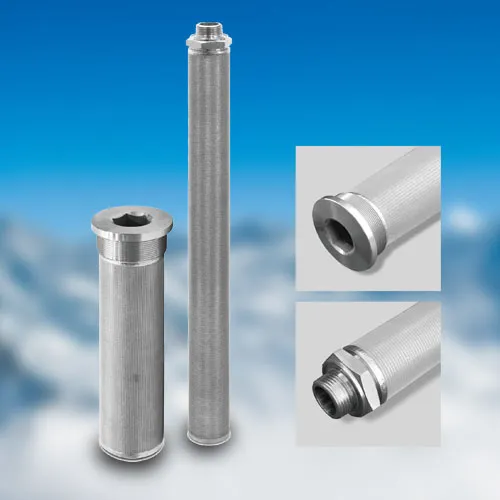
Multi-Layer Sintered Mesh Filter Cartridge
This guide offers a comprehensive analysis of multi-layer sintered mesh filter cartridges, covering vacuum sintering at 1000–1200°C, metallurgical bonding of 2–7 mesh layers, stable pore size, and high structural strength. It compares performance characteristics, identifies key application fields, and provides practical selection and maintenance insights for industrial filtration systems.
- I. Product Overview
- II. Technical Parameters and Material Characteristics
- 2.1 Core Technical Parameters
- 2.2 Material Specifications
- 2.3 Structural Features
- 2.4 Key Performance Advantages
- III. Performance Comparison with Other Porous Materials
- IV. Typical Application Fields
- 4.1 Petrochemical Industry
- 4.2 Chemical Fiber and Film Industry
- 4.3 Pharmaceutical and Bioengineering
- 4.4 Gas Distribution and Fluidization Applications
- 4.5 High-Pressure Backwash Filters
- V. Selection Recommendations
- VI. Maintenance and Service Life
- VII. Conclusion
Multi-Layer Sintered Mesh Filter Cartridge
Comprehensive Analysis of Technical Parameters, Performance Characteristics, and Application Fields
I. Product Overview
The multi-layer sintered mesh filter cartridge is a new type of filtration material manufactured from multiple layers of woven metal wire mesh through a special lamination pressing process followed by vacuum furnace sintering at high temperature. The core production process includes: stacking several layers of wire mesh with different mesh counts in a specific order, applying pressure via a press for initial shaping, and then placing the stack in a vacuum sintering furnace at high temperature (typically 1000–1200°C) under a controlled atmosphere. During this process, solid-state diffusion and localized melting occur at the contact points between layers, forming a strong metallurgical bond and ultimately producing an integral porous material that combines high strength with good toughness.
This process endows the multi-layer sintered mesh filter cartridge with excellent overall strength and structural rigidity, effectively overcoming the inherent shortcomings of traditional single-layer wire mesh – low strength, insufficient rigidity, easy deformation, and unstable pore size. In terms of comprehensive mechanical properties and filtration reliability, the multi-layer sintered mesh filter cartridge significantly outperforms similar products such as metal powder sintered materials, porous ceramics, and metal fiber sintered felts. It has become the preferred filtration solution for demanding operating conditions.
II. Technical Parameters and Material Characteristics
2.1 Core Technical Parameters
| Parameter | Range / Value |
|---|---|
| Filtration accuracy | 2 – 60 μm |
| Operating temperature range | –20 ~ 600°C |
| Maximum differential pressure resistance | 3.2 MPa |
| Number of layers | 2 – 7 layers |
| Standard material | Stainless steel 316L / 304L |
Key Parameter Interpretation:
- Filtration accuracy (2–60 μm): Covers a wide range from coarse to fine filtration. Different accuracy grades can be achieved by adjusting the mesh count and layer combination, meeting diverse process requirements.
- Operating temperature (–20~600°C): Thanks to its all-metal construction and high-temperature sintering process, the cartridge maintains structural stability and filtration performance from cryogenic conditions up to 600°C, making it suitable for extreme applications such as cryogenic processing and high-temperature melt filtration.
- Maximum differential pressure resistance (3.2 MPa): High strength and rigidity ensure no deformation or damage under high differential pressure, particularly suitable for backwashing, high-pressure circulation systems, and other applications with significant pressure fluctuations.
- Number of layers (2–7): By varying the layer count, an optimal balance can be achieved among filtration accuracy, dirt-holding capacity, and mechanical strength.
2.2 Material Specifications
The standard material for the product is stainless steel 316L, which offers a balanced performance in corrosion resistance, high-temperature oxidation resistance, and weldability – making it the first choice for most industrial applications. Stainless steel 304L can also be used for less corrosive environments, providing better economy. For special media (e.g., strong acids, strong alkalis, seawater, organic solvents) or extreme temperature requirements, custom materials such as Hastelloy, Inconel, Monel, and other special alloys are available upon request.
2.3 Structural Features
The standard multi-layer sintered mesh filter cartridge adopts a five-layer composite structure, with each layer having a distinct function and working synergistically:
| Layer | Function |
|---|---|
| Protective layer | The outermost layer with relatively large mesh openings, mainly used to block large particles and protect the precision layers from impact damage |
| Precision control layer | The core filtration layer with the finest mesh openings, determining the final filtration accuracy and undertaking the main retention task |
| Distribution layer | Located beneath the precision layer, it acts as a flow distributor and buffer, ensuring uniform fluid distribution and preventing local high-velocity flow |
| Reinforcement layers (multiple) | Situated at the bottom with coarse mesh openings, providing structural support and compressive strength to ensure overall rigidity |
This gradient composite structure achieves a filtration mechanism of “surface retention as primary, depth capacity as secondary,” which not only ensures high accuracy but also significantly extends the cartridge’s service life.
2.4 Key Performance Advantages
(1) High Strength and Pressure Resistance
High-temperature sintering creates metallurgical bonds at all contact points between layers, resulting in extremely high interlayer bonding strength. The overall rigidity and pressure resistance far exceed those of single-layer mesh or conventional welded mesh. Under a differential pressure of up to 3.2 MPa, the pore structure remains stable without expansion or displacement, ensuring reliable filtration accuracy.
(2) Excellent High-Temperature Performance
The all-metal construction combined with vacuum sintering allows long-term stable operation over a wide temperature range from –20°C to 600°C. Compared with polymer-based filter cartridges (typically ≤100°C), the multi-layer sintered mesh filter cartridge has a clear advantage in high-temperature applications, particularly in molten polymer filtration (e.g., chemical fiber melts) and high-temperature flue gas purification.
(3) Strong Corrosion Resistance
The standard 316L material offers good resistance to most acids, alkalis, and salt media. Combined with the precision sintering process, the cartridge can serve for extended periods in corrosive environments without material degradation.
(4) Excellent Cleanability and Regeneration
With a filtration structure primarily based on surface retention, contaminants mainly accumulate on the surface rather than deep inside the pores. Reverse backwashing (flowing cleaning fluid or gas in the opposite direction) can quickly remove the surface filter cake and restore flow capacity. Combined with ultrasonic cleaning or chemical cleaning, the cartridge can be reused many times, significantly reducing operating costs.
(5) Stable Accuracy and Uniform Porosity
The sintering process ensures uniform pore sizes during pressing and sintering. Consistent pore size distribution from batch to batch guarantees stable and repeatable filtration performance.
III. Performance Comparison with Other Porous Materials
| Comparison Aspect | Multi-Layer Sintered Mesh | Metal Powder Sintered | Porous Ceramic | Metal Fiber Sintered Felt |
|---|---|---|---|---|
| Mechanical strength | (highest) | |||
| Impact/vibration resistance | ||||
| High-temperature resistance | (600°C) | |||
| Filtration accuracy | (2–60μm) | (down to sub-micron) | ||
| Permeability / flux | (high porosity) | |||
| Cleanability / regeneration | (easy backwash) | |||
| Structural rigidity | ||||
| Overall cost |
The multi-layer sintered mesh filter cartridge shows clear advantages in mechanical strength, impact resistance, structural rigidity, and cleanability/regeneration, making it especially suitable for demanding conditions involving high pressure, high flow velocity, and frequent backwashing.
IV. Typical Application Fields
4.1 Petrochemical Industry
- High-temperature media filtration: Purification of high-temperature oils and gases in processes such as catalytic cracking and hydrotreating
- Corrosive media filtration: Filtration of acid and alkali solutions in sour crude processing and acid gas treatment
- Catalyst recovery: Interception and recovery of catalyst particles in fixed-bed and fluidized-bed reactors
- Heat exchanger protection: Installed upstream of heat exchangers to prevent particle clogging of tubes
4.2 Chemical Fiber and Film Industry
- Polymer melt filtration: Precision filtration of molten polymers such as PET, PA, and PP prior to melt spinning, removing gel particles and foreign matter
- Film extrusion protection: Installed before the extruder die to prevent impurities from scratching film surfaces
- Spinning pack filtration: As the core filtration element in spinning packs, ensuring spinning quality and prolonged continuous operation cycles
This field demands extremely high filtration accuracy and temperature resistance. The multi-layer sintered mesh filter cartridge can operate stably at melt temperatures of 280–320°C and is a standard configuration in the chemical fiber industry.
4.3 Pharmaceutical and Bioengineering
- Catalyst separation: Recovery and reuse of precious metal catalysts in hydrogenation, oxidation, and other reactions
- Activated carbon decolorization filtration: Removal of activated carbon particles during API purification
- Fermentation broth clarification: Separation of mycelium and solid impurities from biological fermentation broths
The pharmaceutical industry requires high material purity and cleanability. The 316L multi-layer sintered mesh filter cartridge offers good corrosion resistance and ease of cleaning and sterilization, meeting GMP requirements.
4.4 Gas Distribution and Fluidization Applications
- Gas distribution plates: As air distributor plates in fluidized-bed reactors (e.g., FCC regenerators, drying equipment), providing uniform gas distribution and stable fluidization
- Gas diffusers: As gas dispersion elements in gas-liquid contact equipment to enhance mass transfer efficiency
- Silencing and noise reduction: Used in silencers at high-pressure gas discharge outlets to reduce noise while capturing particulates
In these applications, the high rigidity and uniform porosity of the multi-layer sintered mesh filter cartridge ensure long-term shape stability and uniform gas distribution.
4.5 High-Pressure Backwash Filters
- Fine oil filtration: Online purification of lubricating oils, hydraulic oils, insulating oils, etc.
- Process water reuse: Side-stream filtration of circulating cooling water in steel, power, and other industries
- High-pressure gas well filtration: Interception of sand and impurities at wellheads during natural gas production and transportation
When combined with automatic backwashing systems, the multi-layer sintered mesh filter cartridge enables unattended continuous filtration, greatly reducing manual maintenance costs.
V. Selection Recommendations
| Consideration | Recommendation |
|---|---|
| Filtration accuracy | Coarse (>50 μm) → 2–3 layers; Fine (5–50 μm) → 4–5 layers; Ultra-fine (2–5 μm) → 6–7 layers |
| Operating temperature | Ambient ~300°C → 304L; 300–600°C or strongly corrosive → 316L; Extreme or special media → Hastelloy or other alloys |
| Operating pressure / differential pressure | Stable low pressure → 2–3 layers; High fluctuating pressure → 5–7 layers reinforced |
| Cleaning method | Frequent backwashing → 5+ layers for higher strength; Chemical cleaning preferred → 4–5 layers |
| Media corrosiveness | Neutral / mildly corrosive → 304L; Acid/alkali/salt media → 316L; Strongly corrosive → special alloys |
VI. Maintenance and Service Life
The multi-layer sintered mesh filter cartridge does not require complete replacement during its design life. Regular backwashing can restore most of its filtration performance. When backwashing becomes less effective, the following deep-cleaning methods may be used:
- Ultrasonic cleaning: Immerse the cartridge in cleaning solution and apply ultrasonic vibration to remove fine particles embedded in the micropores.
- Chemical soak cleaning: For specific contaminants (e.g., oil fouling, scaling, organic residues), use appropriate chemical agents to dissolve them.
- High-temperature baking: For cartridges heavily clogged with organic contaminants, high-temperature baking in a controlled atmosphere can carbonize and remove the organics.
With proper cleaning and maintenance, the service life of the multi-layer sintered mesh filter cartridge can reach 3 to 5 years or even longer, providing significantly better overall economy than disposable filter cartridges.
VII. Conclusion
The multi-layer sintered mesh filter cartridge, with its comprehensive advantages of high strength, high-temperature resistance, corrosion resistance, and easy cleanability, plays an irreplaceable role in petrochemicals, chemical fiber melt filtration, pharmaceutical separation, gas distribution, and high-pressure backwash filtration. Its multi-layer composite gradient structure balances filtration accuracy and mechanical strength, making it the preferred filtration solution for demanding conditions such as high differential pressure, high temperature, and high corrosivity. Proper selection and standard maintenance practices can maximize the performance benefits of the multi-layer sintered mesh filter cartridge, delivering long-term stable operation and cost savings for users.
Please login to write a comment after