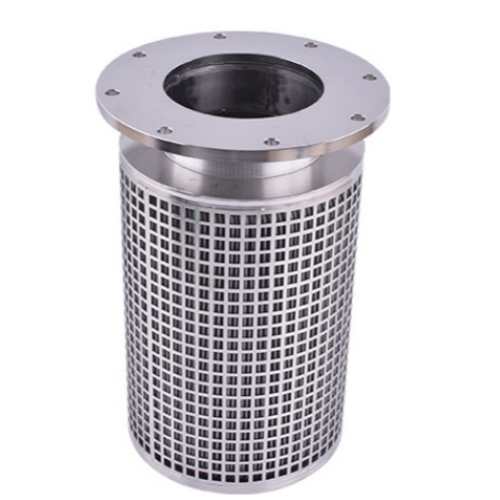
Stainless Steel Sintered Wire Mesh
Stainless steel sintered wire mesh is a composite filtering material made by laminating, pressing and vacuum high-temperature sintering of multi-layer stainless steel woven mesh. The metal wires of each layer form a metallurgical bond at high temperature, which significantly improves the overall strength and channel stability. It combines the filtration accuracy of metal mesh with the high strength of sintered structure, enabling surface and deep dual filtration, and is suitable for harsh working conditions such as high pressure, high temperature and strong corrosion.
Core Features
- Material: Commonly used 304/316L stainless steel, which can be extended to Hastelloy, titanium mesh, etc.
- Filtration Accuracy: 1–500μm, and the combination of multi-layer meshes can be customized on demand.
- Structural Characteristics: Standard five-layer structure (protective layer, filter layer, shunt layer, support layer, reinforcement layer) with gradient distribution of channels and strong backwashing regeneration capacity.
- Key Performance: Temperature resistance from -200℃ to 1150℃, pressure resistance up to 48MPa, corrosion resistance, low flow resistance, and can be repeatedly cleaned and regenerated.
- Common Forms: Sintered wire mesh sheet/board, sintered wire mesh filter cartridge, filter cylinder, filter disc, filter barrel, etc.
Main Applications
Chemical industry (catalyst recovery, reactor exhaust), petrochemical industry (high-pressure fluid filtration), pharmaceutical industry (precision filtration of liquid medicine, GMP clean filtration), food and beverage, hydraulic systems, water treatment, high-temperature flue gas dust removal, aerospace, etc.
Core Differences from Ordinary Wire Mesh
Compared with ordinary single-layer metal mesh, stainless steel sintered wire mesh has a multi-layer sintered integral structure with metallurgical bonding, which has higher strength and pressure resistance, and is suitable for high-pressure working conditions. Its filtration accuracy is stable and controllable, with gradient channels, strong backwashing and regeneration ability, long service life, and can adapt to harsh environments such as high temperature and strong corrosion. In contrast, ordinary single-layer metal mesh has weak structural strength, its accuracy depends on the mesh, which is easy to deform and lose stability, and it is easy to clog with short service life, only suitable for conventional working conditions.
Tips for Foreign Trade and Official Website Adaptation
Keywords such as material (304/316L), precision range, temperature and pressure resistance, backwashing characteristics, and customizable filter cartridges/cylinders can be marked on the product page. At the same time, provide Chinese and English parameter tables and application scenario pictures to facilitate overseas customers to quickly select models.